2025 Market Outlook: Crypto Slide, AI Fears, Housing Crisis and What Comes Next
The week ending December 5, 2025 delivered a lot of noise in markets and even more confusion about the big structural forces shaping the economy. Stocks rallied hard. Crypto stumbled. AI fears resurfaced. And the housing market continues to choke under the weight of rising rates and broken supply dynamics.
Below is a deep, organized look at what is really going on.
Market Snapshot
During the shortened Thanksgiving week, the S&P 500 jumped 3.7 percent and the Nasdaq climbed 4.9 percent. These gains erased the AI-driven correction from two weeks earlier. The market sits just below all-time highs.
Why the strength?
Several Federal Reserve governors publicly supported a December rate cut, triggering short covering among hedge funds that had leaned too bearish.
But the enthusiasm may be misplaced. Even if the Fed trims by 25 basis points, this is only minor tinkering. Rates are not returning to zero. The long-term story is driven by larger forces: AI, structural inequality, and the affordability breakdown across key sectors like housing.
What Is Happening in Crypto
Bitcoin has fallen from 125,000 in September to roughly 92,000. Other major cryptocurrencies show similar patterns.
The commentary surrounding the drop is revealing. Analysts describe technical weakness, forced margin selling, and year-end tax positioning. Notice what no one talks about: fundamentals or valuation metrics. Crypto has no traditional valuation anchors, which makes it impossible to know where the bottom is. Investors are trading a dream rather than cash flows or economic anchors.
AI and the Collapse in Software Stocks
Salesforce is a useful case study. Earnings for 2025 are up 25 percent, yet the stock is down 25 percent. The fear is simple. Investors worry that AI will reduce the cost of producing software and erode the moats that protected large software companies for decades.
Some analysts argue that AI has not significantly reduced software development costs. Others believe the threat is existential. It is too early to know. Salesforce reported mixed results, but it offered stronger fourth quarter guidance, sending the stock up 4 percent. Still, the core concern remains unresolved.
Housing Stocks: What Is Their Real State
Housing stocks fall into two groups: homebuilders and building product companies. Both are struggling.
Homebuilders
Modern homebuilders are better run than before the financial crisis. They no longer load their balance sheets with land and have become more disciplined about margins. But the business remains deeply cyclical and heavily tied to mortgage rates.
With rates far above COVID-era lows, demand is soft. Builders have been using incentives through their mortgage subsidiaries to move units, which hurts margins. Despite weak fundamentals, stocks like DHI, LEN, and PHM are up this year due to hopes of lower rates in 2026 and 2027. Their relatively small market caps also make them magnets for institutional rate speculation.
Market structure has changed too. Public builders now construct about half of new homes, double their share in 2001.
Building Product Companies
Companies tied to existing home sales are suffering even more. Home Depot, Lowe’s, Stanley Works, Trex, and Whirlpool are flat to down, with declining earnings. With roughly half of US homeowners locked into mortgages of 4 percent or less, existing home turnover has collapsed. Discretionary categories like decking and appliances are hurting the most.
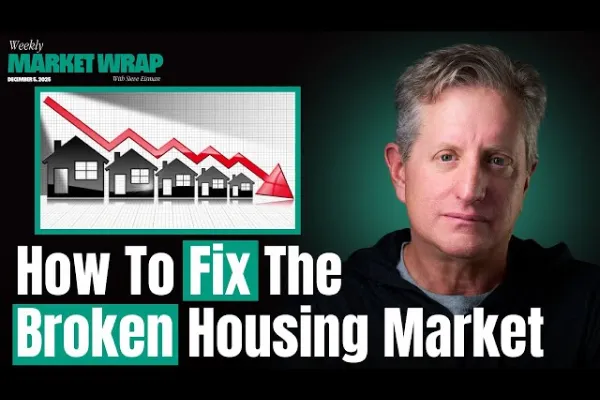
Why Housing Is So Unaffordable
Affordability is at its worst level in decades. The entry-level affordability index shows that it now takes about 60 percent of an entry-level buyer’s income to afford a median-priced home. Only the late 1970s inflation spike was worse.
Several factors are making the crisis worse:
1. Locked-In Homeowners
Half of homeowners have mortgages at 4 percent or lower. If a seller moves, they must trade into a new mortgage at rates closer to 6.25 percent. To keep the same monthly payment, a buyer would require a price drop of at least 25 percent, which is unlikely in a strong labor market.
This locks up supply and pushes inventory to multi-decade lows.
2. Prices Have Outpaced Income
Home prices have grown faster than both inflation and wages.
3. We Have Underbuilt by About 5 Million Homes
Over the past decade, we simply did not build enough. The primary issue is not demand. People want homes. The issue is structural supply constraints.
4. Local Regulations Make Building Affordable Homes Impossible
The biggest barriers include:
Minimum square footage rules
Lengthy and expensive permitting processes
Impact fees that add 10 to 15 percent to the cost
Zoning restrictions that block smaller homes or higher-density development
Politicians often propose demand-side solutions like down payment assistance or 50-year mortgages. These inflate prices further and do nothing for supply.
Real change requires federal pressure on states and municipalities to relax zoning, cut fees, streamline approvals, and allow smaller, cost-effective construction.
5. Outdated Construction Methods
In Sweden, nearly half of homes are factory-built at 30 percent lower cost. The US still builds mostly on-site, one unit at a time. Industrialized housing could dramatically reduce cost pressures.
ETFs vs Mutual Funds: A Simple Breakdown
A reader asked about the difference between passive ETFs, active ETFs, and mutual funds.
Passive ETFs mirror an index with extremely low fees.
Active ETFs and mutual funds involve manager stock selection.
Active ETFs trade throughout the day, disclose holdings daily, are more tax efficient, and usually charge lower fees than mutual funds.
All else equal, the active ETF structure is superior. But long-term performance always outweighs structure.
Final thoughts
The biggest themes heading into 2026 are clear.
Crypto lacks valuation anchors.
AI is reshaping software economics.
Housing supply is fundamentally broken at a local level.
Rates remain the lever moving markets in the short term.
Until policymakers directly confront supply constraints, affordability will continue to deteriorate.If you want more of these weekly wrap-ups, interviews and financial literacy content, check out our YouTube channel and realismanplaybook.com. And I’ll see you next week.
Thanks for reading this week’s wrap.
If you’d like to catch my interviews and market breakdowns, visit The Real Eisman Playbook or subscribe to the Weekly Wrap channel on YouTube.
This post is for informational purposes only and does not constitute investment advice. Please consult a licensed financial adviser before making investment decisions.


