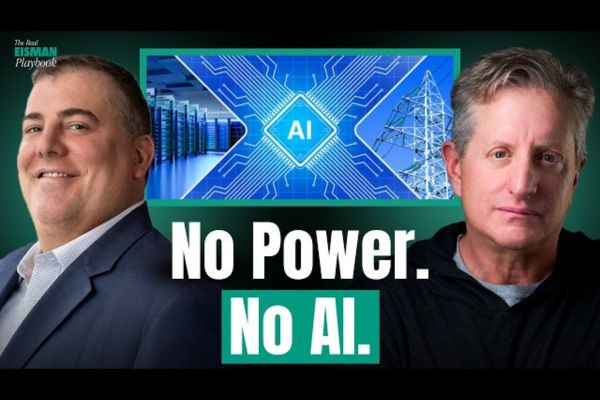
AI's Biggest Bottleneck Is Power, Not Chips | Steve Eisman
How data centers, grid infrastructure, and energy companies are shaping the next phase of the AI revolution
Artificial intelligence may dominate headlines, but behind every breakthrough model lies a much less glamorous challenge: electricity.
While semiconductor companies like NVIDIA continue to capture investor attention, Steve Eisman argues that the real bottleneck for AI isn't computing power—it's the infrastructure required to power it.
In a recent conversation with Baird analyst Ben Kallo, Eisman explored how surging electricity demand is transforming utilities, energy infrastructure, electric vehicles, and even the future of nuclear power.
Their conclusion is clear: if AI continues expanding at its current pace, the companies building and supplying America's electrical grid may become some of the biggest winners of the decade.
AI Needs More Than Chips
The AI boom has created unprecedented demand for computing power.
But powerful GPUs alone don't run artificial intelligence.
They require massive data centers, and those data centers require enormous amounts of reliable electricity.
According to Kallo, the U.S. electrical grid was already under pressure before AI became mainstream.
Several long-term trends were already increasing electricity demand, including:
Manufacturing returning to the United States
Aging power infrastructure
Electrification of homes and transportation
Retirement of older coal plants
AI has simply accelerated an existing problem.
The result is one of the largest infrastructure buildouts the energy industry has seen in decades.
America's Grid Is Entering a New Growth Cycle
One of the most surprising takeaways from the discussion is the sheer scale of electricity expansion.
The United States is expected to add roughly 30 gigawatts of new power generation every year over the next several years.
To put that into perspective, that represents enough electricity to power millions of additional homes annually.
Much of this new capacity isn't designed for residential consumers.
It's being built specifically to support AI infrastructure.
Data centers operate around the clock, requiring reliable "base load" electricity that cannot simply disappear when the sun stops shining or the wind slows down.
That makes dependable energy sources increasingly valuable.
Building Data Centers Is Harder Than It Looks
Despite the excitement surrounding AI, constructing data centers is proving far more complicated than many investors assume.
According to Kallo, the primary constraints aren't demand—they're execution.
Major challenges include:
Labor shortages
Limited power availability
Grid interconnection delays
Permitting requirements
Equipment shortages
Many developers pursue multiple projects simultaneously, knowing only a fraction will ultimately be completed.
This has created confusion in the market, where announcements often exceed actual construction.
Even successful projects can experience delays as companies wait for newer generations of AI hardware before committing billions of dollars to long-term infrastructure.
GE Vernova Is Quietly Becoming an AI Infrastructure Leader
One company receiving significant attention is GE Vernova.
While many investors associate AI with software companies, GE Vernova sits much closer to the physical infrastructure powering the revolution.
Its businesses include:
Natural gas turbines
Grid electrification equipment
High-voltage transformers
Nuclear technology
Wind energy
Demand for gas turbines has become so strong that new orders today may not be delivered until 2030 or later.
That multi-year backlog gives the company unusually strong revenue visibility.
Beyond power generation, GE Vernova also supplies many of the transformers and electrical components required to connect new data centers to the grid.
As AI infrastructure expands, these products become increasingly essential.
Nuclear Power May Have a Second Act
Although still years away from meaningful commercialization, small modular reactors (SMRs) remain an area of growing interest.
Unlike traditional nuclear plants, SMRs are designed to generate power at a smaller scale, making them suitable for:
Large industrial facilities
Data centers
Smaller communities
GE Vernova is developing SMR technology through its partnership with Hitachi and expects its first projects to become operational during the 2030s.
While the timeline remains uncertain, nuclear power could eventually become an important long-term solution for AI's expanding electricity needs.
Tesla Is Becoming More Than an Automaker
Tesla remains one of the most debated companies in the market.
Ben Kallo believes investors should think of Tesla as far more than an electric vehicle manufacturer.
While EV sales continue growing globally, Tesla's automotive business has matured.
Future growth increasingly depends on several new businesses, including:
Autonomous driving
Robotaxis
Energy storage
Artificial intelligence
Robotics
Kallo argues that Tesla's massive fleet of connected vehicles provides a significant competitive advantage.
Every Tesla on the road continuously collects driving data that helps improve autonomous driving software, creating a feedback loop competitors struggle to match.
Steve Eisman remains more skeptical, noting that fully autonomous driving has repeatedly taken longer than Elon Musk has predicted.
Tesla's Energy Business Is Becoming a Major Contributor
One of Tesla's least discussed businesses is also one of its fastest-growing.
Its energy division produces large-scale battery storage systems known as Megapacks, which help utilities stabilize electrical grids.
These battery systems store excess electricity and release it during periods of peak demand.
As renewable energy adoption increases and electricity demand grows, grid-scale storage is becoming increasingly important.
Today, Tesla's energy business contributes a meaningful share of the company's operating income and helps fund future investments in robotics and autonomous driving.
Could SpaceX Eventually Buy Tesla?
One of the more intriguing ideas discussed during the interview was the possibility of a future merger between SpaceX and Tesla.
Kallo believes such a transaction could simplify capital allocation while giving Elon Musk greater control over AI development across both companies.
Potential synergies could include:
Joint AI development
Semiconductor manufacturing
Solar energy expansion
Robotics
Autonomous transportation
Energy infrastructure
Eisman questioned whether combining so many businesses under one company would create unnecessary complexity.
While purely speculative today, the discussion highlights how closely AI, transportation, energy, and aerospace are becoming interconnected.
Solar Still Faces Policy Uncertainty
Despite strong long-term demand for electricity, solar manufacturers continue facing regulatory uncertainty.
Companies like First Solar remain highly sensitive to U.S. trade policy, particularly tariffs on imported solar panels and polysilicon.
Until tariff policies become clearer, many customers are delaying purchasing decisions.
For investors, this creates near-term uncertainty despite favorable long-term industry fundamentals.
Labor May Become AI's Biggest Constraint
Technology often dominates AI conversations, but Kallo points to another growing challenge: skilled labor.
Building data centers, power plants, substations, and transmission lines requires thousands of:
Electricians
Engineers
Construction workers
Utility specialists
Even with sufficient capital and demand, projects cannot move forward without the workforce needed to build them.
As AI infrastructure accelerates, labor shortages may become one of the industry's most significant limiting factors.
Final Thoughts
The AI revolution is no longer just about software or semiconductors.
Its success increasingly depends on physical infrastructure—power generation, electrical grids, transmission equipment, and the workforce capable of building it all.
Companies like GE Vernova may never generate the excitement of NVIDIA or Tesla, but they provide the critical infrastructure that allows AI to scale.
For investors, understanding where electricity comes from may soon become just as important as understanding where computing power comes from.
As Steve Eisman concludes, AI's future won't be determined solely by better chips or smarter software—it will depend on whether the world can generate enough energy to support the next generation of innovation.
Until next time, this is Steve Eisman, and this has been The Real Eyes Playbook. .
If you’d like to catch my interviews and market breakdowns, visit The Real Eisman Playbook or subscribe to the Weekly Wrap channel on YouTube.
This post is for informational purposes only and does not constitute investment advice. Please consult a licensed financial adviser before making investment decisions.


