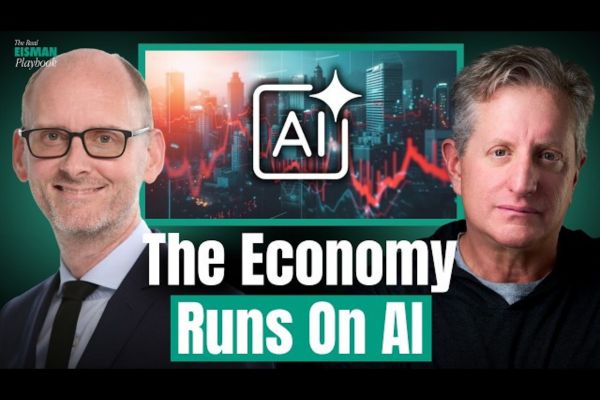
AI, Economy & Investing: Key Insights from Steve Eisman Podcast
Artificial intelligence is no longer just a technology story—it has become one of the biggest forces shaping the global economy, financial markets, and investment portfolios.
In a recent episode of The Real Eisman Playbook, Steve Eisman sat down with Torsten Sløk, Chief Economist at Apollo, to discuss the major economic themes defining today's market. Their conversation covered everything from AI-driven growth and interest rates to employment, private credit, Europe, government debt, and the long-term risks investors should be watching.
Here's a breakdown of the key insights from that discussion.
AI Has Become the Largest Driver of U.S. Economic Growth
According to Sløk, roughly half of current U.S. GDP growth is being fueled by AI-related spending.
Normally, the U.S. economy grows around 2% annually. Today, approximately 1% of that growth comes directly from investments in AI infrastructure—including massive spending on data centers, semiconductor manufacturing, computing power, and energy required to support AI systems.
Unlike previous technology cycles, AI is creating an entirely new investment wave that stretches far beyond software companies. Construction firms, utilities, semiconductor manufacturers, cloud providers, and infrastructure companies are all benefiting from this unprecedented capital spending.
The scale is unlike anything seen in decades.
Three Forces Are Supporting the Economy
Sløk highlighted three major tailwinds currently keeping the U.S. economy surprisingly resilient.
1. The AI Investment Boom
Billions of dollars are flowing into AI infrastructure.
Major technology companies continue investing aggressively in data centers, chips, networking equipment, and power generation. These investments are boosting economic activity even while interest rates remain elevated.
2. Re-Industrialization
The U.S. is seeing a manufacturing revival driven by:
Semiconductor production
Defense manufacturing
Pharmaceutical production
Domestic supply chain investments
Government initiatives like the CHIPS Act have encouraged companies to build more manufacturing capacity inside the United States.
While this contributes less than AI to GDP growth, it remains an important long-term trend.
3. Consumer Tax Relief
Recent tax changes have also boosted consumer spending.
Many households received larger tax refunds than in previous years, giving consumers additional disposable income and supporting retail spending throughout the year.
However, Sløk notes that this is a temporary benefit and will likely fade in future years.
Why Higher Interest Rates Haven't Slowed the Economy
Typically, higher interest rates reduce borrowing, investment, and consumer spending.
But today's economy is behaving differently.
That's because the biggest sources of growth—AI investment, government-supported manufacturing, and tax-related consumer spending—are relatively insensitive to interest rates.
The sectors that normally respond most strongly to higher rates, such as housing and automobiles, are already slowing.
Meanwhile, AI spending continues almost regardless of borrowing costs.
The Federal Reserve Faces a Difficult Challenge
With economic growth remaining strong and inflation still elevated, Sløk believes the Federal Reserve has little reason to cut interest rates in the near term.
Persistent inflation is being supported by several factors:
Strong economic activity
Higher energy prices
Tariffs
Rising costs associated with AI infrastructure
Large-scale AI projects have increased demand for labor, semiconductors, electricity, and construction materials, all of which contribute to inflationary pressures.
As a result, markets have shifted from expecting rate cuts to considering the possibility of additional rate hikes.
AI Is Becoming an Extremely Capital-Intensive Business
One of the most fascinating parts of the discussion centered on how quickly the economics of AI have changed.
Just a year ago, many technology companies could finance AI investments using existing cash flow.
Today, capital requirements have exploded.
Major technology firms are raising enormous amounts of money to finance AI infrastructure, data centers, and computing capacity.
This raises an important question:
Will these massive investments ultimately generate sufficient returns?
The Biggest Question: Are There Any Moats?
Steve Eisman raised what may be the most important investment question surrounding AI.
Unlike traditional technology businesses, AI models appear increasingly interchangeable.
Users frequently switch between:
ChatGPT
Claude
Gemini
Other emerging models
If customers can easily move between competing platforms, companies may struggle to build lasting competitive advantages.
Without strong pricing power, enormous infrastructure spending could become difficult to justify.
The discussion suggests that while demand for AI computing will likely continue growing, future profitability may not.
Open Source AI Creates Additional Pressure
Another emerging challenge is the rapid improvement of open-source AI models.
Lower-cost alternatives—particularly from China—could significantly reduce the price businesses are willing to pay for AI services.
Although concerns around data privacy and security may encourage many organizations to remain with trusted U.S. providers, increasing competition could place downward pressure on profits across the industry.
Understanding the K-Shaped Economy
One of the conversation's most important themes was the growing divide between high-income and low-income households.
This phenomenon is often referred to as a K-shaped economy.
Simply put:
Some people continue getting wealthier while others struggle financially.
According to Sløk, the divide exists across three areas.
Wealth
Higher-income households have accumulated trillions of dollars in additional savings since 2019 through:
Rising stock prices
Higher home values
Attractive investment income
Meanwhile, lower-income households have seen little improvement in savings.
Income Growth
Wage growth has also become uneven.
Higher-income workers continue seeing stronger income growth than many workers at the lower end of the income spectrum.
Inflation
Inflation has affected households differently.
Lower-income families spend a greater percentage of their income on necessities like:
Food
Housing
Energy
Since these categories experienced some of the largest price increases, inflation has had a much greater impact on lower-income consumers.
Why Consumer Spending Remains Strong
Despite growing inequality, overall consumer spending has remained healthy.
That's because higher-income households account for a disproportionately large share of total consumption.
Luxury retailers continue performing well, while discount retailers face greater challenges.
This imbalance explains why headline economic data often appears stronger than many households actually experience.
Private Credit Looks Healthy—Except for Software
Private credit has expanded dramatically since banking regulations tightened after the Global Financial Crisis.
Overall credit conditions remain relatively stable.
Default rates have declined.
Corporate distress has eased.
However, one sector stands out:
Software.
Many software companies borrowed heavily during the low-interest-rate environment of 2021 and 2022.
Today they face:
Higher interest costs
Lower valuations
Potential AI disruption
Many of these loans mature around 2028 and 2029.
If interest rates remain elevated, refinancing could become extremely difficult.
As Steve Eisman pointed out, lenders may require private equity owners to inject significant additional capital before agreeing to refinance these businesses.
Fortunately, Sløk believes this remains more of a sector-specific issue than a systemic financial risk.
AI Is Not Destroying Employment—At Least Not Yet
Despite widespread concerns about automation, the labor market remains remarkably strong.
Job growth continues exceeding expectations.
Even more surprising, employment among younger workers has improved.
One possible explanation is entrepreneurship.
AI tools dramatically reduce the cost of starting businesses.
Individuals now have access to software capable of handling tasks that previously required entire teams.
While AI is eliminating some jobs—particularly in areas such as telemarketing—it is simultaneously creating opportunities for entirely new businesses.
The result is a more dynamic labor market rather than widespread unemployment.
Why the U.S. Economy Continues to Outperform Europe
Steve Eisman and Torsten Sløk also explored why Europe's economy continues to lag behind the United States.
Several structural issues stand out:
Rigid labor markets
Difficult hiring and firing rules
Less competitive industries
Heavier regulation
Limited access to risk capital
Unlike the U.S., where entrepreneurs can obtain financing from banks, venture capital, private equity, private credit, or public markets, European businesses often rely primarily on traditional banks.
This makes innovation slower and business creation more difficult.
Many European entrepreneurs ultimately relocate to the United States in search of funding and growth opportunities.
Is the U.S. Deficit a Crisis?
The U.S. government continues running large budget deficits while national debt keeps climbing.
Although this concerns many investors, Sløk argues the situation is not yet critical.
Why?
Global investors continue purchasing:
U.S. Treasury bonds
Corporate credit
American equities
Foreign investors still view the United States as offering stronger economic growth and better investment opportunities than many other regions.
However, long-term concerns remain.
Demand for long-duration Treasury bonds has weakened as institutional investors increasingly allocate capital toward private infrastructure, energy, and AI projects offering potentially better returns.
The current path of government debt is widely viewed as unsustainable over the long run, even if immediate risks remain manageable.
The Biggest Investment Risk May Be Hidden in Plain Sight
Perhaps the most important takeaway from the discussion was how deeply AI has become embedded across investment portfolios.
Many investors believe they are diversified with a traditional 60/40 portfolio.
In reality:
A significant portion of the S&P 500 is heavily concentrated in AI-related companies.
Investment-grade bond indexes increasingly include debt issued by AI hyperscalers.
Venture capital funding is overwhelmingly directed toward AI startups.
Investors may appear diversified across stocks, bonds, and private markets.
But in practice, much of that exposure depends on one underlying theme:
Artificial intelligence.
If AI continues delivering transformational growth, this positioning may prove beneficial.
If expectations prove overly optimistic, however, many seemingly diversified portfolios could experience significant losses simultaneously.
Final Thoughts
Artificial intelligence is reshaping the economy faster than almost any technological development in modern history.
It is driving GDP growth, fueling massive corporate investment, creating new businesses, influencing monetary policy, and transforming financial markets.
At the same time, investors should remain mindful of important risks.
Questions surrounding competitive advantages, profitability, valuation, and capital intensity have yet to be fully answered.
The U.S. economy remains remarkably resilient, but much of that strength is increasingly tied to AI.
As Steve Eisman concluded, the future doesn't simply depend on whether AI changes the world—it almost certainly will.
The more important question is whether today's market expectations accurately reflect tomorrow's economic reality.
For investors, understanding that distinction may be one of the most important challenges in the years ahead.
Until next time, this is Steve Eisman, and this has been The Real Eyes Playbook. .
If you’d like to catch my interviews and market breakdowns, visit The Real Eisman Playbook or subscribe to the Weekly Wrap channel on YouTube.
This post is for informational purposes only and does not constitute investment advice. Please consult a licensed financial adviser before making investment decisions.


