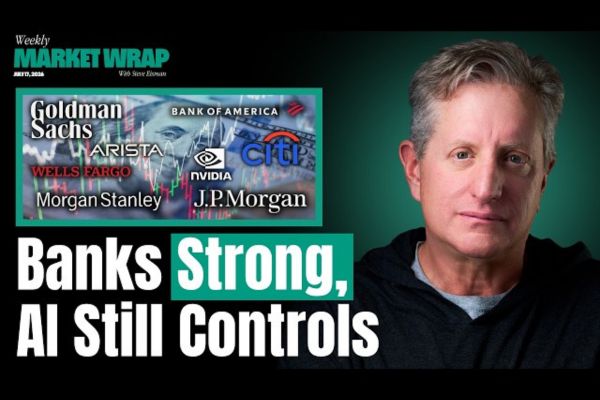
Why AI, Not Banks, Could Determine the Future of the U.S. Economy | Steve Eisman
Why AI, private credit, and corporate earnings matter more than bank performance in 2026
For years, one of the most reliable ways to gauge the health of the U.S. economy was to watch the banking sector. Strong banks typically meant a strong economy, while deteriorating bank credit quality often signaled recession.
But according to Steve Eisman, that relationship may have fundamentally changed.
In this week's market wrap, Eisman examines major earnings reports across banking, technology, healthcare, and payments, concluding that the biggest risks facing the economy no longer originate from traditional banks. Instead, the future may depend on two powerful forces: artificial intelligence and private credit.
Bank Earnings Still Point to a Healthy Economy
Earnings season began with reports from the largest U.S. banks, including JPMorgan Chase, Bank of America, Wells Fargo, and Citigroup.
Despite growing concerns surrounding private credit and potential economic weakness, the data coming from these institutions tells a surprisingly positive story.
The key metric Eisman focuses on is non-accrual loans—loans that are seriously delinquent and no longer generating interest income. Historically, rising non-accrual loans have been one of the clearest warning signs of an approaching credit crisis.
That isn't happening today.
Across the major banks:
Consumer credit quality remains stable.
Commercial loan performance remains healthy.
Non-accrual loan balances are either flat or declining compared to both last quarter and last year.
Unlike the years leading into the Global Financial Crisis, today's banking system continues to show remarkably strong credit fundamentals.
Why Banks Are No Longer the Best Economic Indicator
Historically, Steve Eisman has often said:
"As the banks go, so goes the economy."
This time, however, he believes that rule no longer applies.
Following years of tighter regulation and stronger capital requirements after the 2008 financial crisis, large U.S. banks are exceptionally well-capitalized. Their balance sheets remain healthy, and their lending portfolios show few signs of widespread stress.
Instead, the areas of concern are developing outside traditional banking.
The biggest risks are now concentrated in:
AI-driven disruption
Private credit markets
Software industry financing
These sectors are significantly less transparent than banks, making future economic weakness much harder to identify in advance.
AI Is Reshaping Entire Industries
Artificial intelligence continues to dominate corporate investment decisions, but not every company is benefiting equally.
One of the week's biggest surprises came from IBM.
The company reported disappointing earnings and revenue while citing a rapid shift in customer spending during the final weeks of the quarter.
Instead of investing in software, many enterprise customers redirected budgets toward AI-related infrastructure, including:
Servers
Memory
Storage
Semiconductor hardware
The result was IBM's worst single-day stock decline on record, dragging much of the software sector lower.
According to Eisman, investors have long worried about AI's long-term impact on software companies. IBM's results suggest those effects are already becoming visible today.
AI Winners Continue to Separate Themselves
While software companies struggled, semiconductor-related businesses continued to benefit from massive AI infrastructure spending.
ASML, one of the world's leading manufacturers of semiconductor production equipment, reported:
Strong revenue growth
Better-than-expected earnings
Higher forward guidance
The contrast highlights one of the defining themes of today's market:
Companies enabling AI infrastructure continue to outperform, while many traditional software providers face increasing competitive and spending pressures.
Stablecoins Are Becoming a Competitive Battlefield
The payments industry also saw significant developments.
Circle, issuer of the USDC stablecoin, experienced a volatile week after two major announcements.
First, a consortium including Visa, Mastercard, Stripe, Coinbase, and BlackRock introduced plans for a competing stablecoin ecosystem.
Shortly afterward, Circle received regulatory approval to operate as a trust bank.
While the banking charter allows Circle to improve profitability by managing its own assets, Eisman believes the competitive threat is far more significant.
Creating a stablecoin is relatively straightforward.
Building a global payment network is not.
With Visa and Mastercard entering the space directly, Circle may ultimately need to partner with—or even sell to—a larger player in order to remain competitive.
Consolidation May Be Coming to Payments
Reports also surfaced that PayPal could become an acquisition target.
Although unconfirmed, Eisman believes consolidation across the payments industry would make strategic sense.
Competition continues to intensify as payment companies increasingly expand into one another's markets, making scale more valuable than ever.
Healthcare Earnings Show Pricing Power Matters
Health insurers delivered mixed but generally encouraging results.
Both Elevance Health and UnitedHealth continue to recover from the elevated healthcare costs experienced over the past year.
The biggest driver has been pricing.
Companies that successfully increased premiums have begun restoring profit margins, even if membership growth remains under pressure.
For investors, the message is clear:
In today's healthcare environment, pricing discipline matters more than volume growth.
Netflix and GE Aerospace Reveal High Market Expectations
Several well-known companies reminded investors how demanding today's market has become.
Netflix delivered results largely in line with expectations but announced it would significantly reduce the frequency of its engagement reporting.
The market reacted negatively, viewing both the earnings and reduced transparency as signs of slowing momentum.
GE Aerospace reported outstanding financial performance and raised guidance.
Yet the stock still declined because investors had hoped for an even larger increase.
Strong results alone are no longer enough.
Companies must consistently exceed already elevated expectations to satisfy investors.
Investment Banking Is Entering a Golden Age
While traditional lending remains stable, investment banking is booming.
Major financial institutions posted exceptional results, driven by:
Strong trading activity
Increased mergers and acquisitions
Robust IPO markets
Massive financing needs created by AI investment
Goldman Sachs, Morgan Stanley, JPMorgan, and Bank of America all generated impressive returns on tangible common equity, reinforcing the strength of capital markets businesses.
According to Eisman, Wall Street is becoming one of the biggest indirect beneficiaries of the AI investment cycle.
The Biggest Economic Question Isn't About Banks
Perhaps the most important conclusion from this week's analysis is that the traditional warning signs of recession are simply not present.
Bank credit quality remains healthy.
Consumer lending remains stable.
Commercial loan performance continues to hold up.
Instead, future economic weakness—if it arrives—is more likely to originate from outside the banking system.
Artificial intelligence will determine how businesses allocate capital, how software companies adapt, and how private credit performs over the coming years.
Rather than asking whether banks are healthy, investors should increasingly ask whether AI investments generate sustainable returns and whether private credit markets remain resilient.
Those questions may ultimately determine the direction of the U.S. economy.
Final Thoughts
The 2026 earnings season is reinforcing an important shift in how investors should evaluate economic risk.
Banks remain profitable, well-capitalized, and supported by healthy credit quality. The traditional banking system is no longer the primary source of concern.
Instead, the next chapter of the economy may be written by AI adoption, private credit performance, and the companies building the infrastructure behind both.
For investors, understanding these structural changes could prove far more valuable than watching the traditional recession indicators of the past.
Thanks for reading this week’s wrap.
If you’d like to catch my interviews and market breakdowns, visit The Real Eisman Playbook or subscribe to the Weekly Wrap channel on YouTube.
This post is for informational purposes only and does not constitute investment advice. Please consult a licensed financial adviser before making investment decisions.


