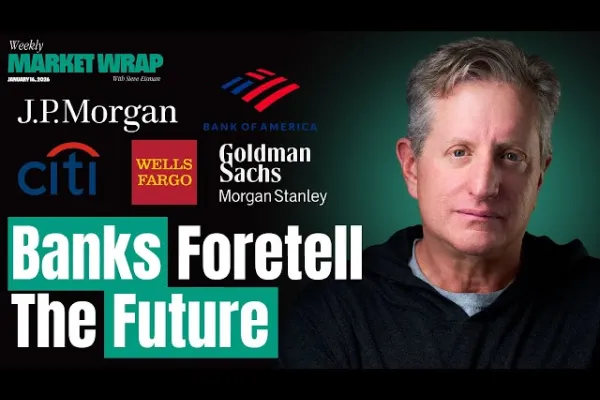
Why Tech Dominates the Market and Why the Next Selloff Could Be Fast and Brutal - Copy
Banks, Tech Dominance, and Affordability: Reading the Economy Through Earnings
This is the first full week of earnings season for 2026, and as always, it begins with the banks. That matters because banks sit at the center of the economic system. They lend to businesses, consumers, developers, and governments. If stress is building anywhere in the economy, it almost always shows up in bank data first.
But before turning to earnings, this week provides an opportunity to step back and connect the dots between the major themes of 2025 and the deeper structural forces reshaping markets over the past decade.
Connecting the Themes
In the 2025 year-end wrap, four themes defined the year:
A K-shaped economy
The AI revolution or a potential AI bubble
Concerns about private credit growth
Affordability pressures on consumers
In the first wrap of 2026, five longer-term structural themes were outlined:
Tech and tech-related stocks dominate the market
Traditional consumer stocks matter less and less
Despite consumers driving 70 percent of GDP, consumer stocks no longer drive the market
The stock market has become detached from everyday life
Index investing reinforces all of the above
These are not separate stories. They are different layers of the same system.
Tech Dominance and the K-Shaped Economy
Over the past decade, the technology sector has grown from roughly 21 percent of the S&P 500 to about 35 percent today. That figure understates the true dominance of tech.
When companies such as Google, Meta, Amazon, and Netflix are included, tech broadly defined accounts for at least 50 percent of the index. No other developed market in the world has this level of concentration.
This mirrors the K-shaped economy itself. The benefits of market gains have flowed disproportionately to the top 10 percent of income earners, while the bottom 80 to 90 percent of consumers have faced relentless inflation in housing, healthcare, insurance, and everyday necessities.
As consumers struggle, the sectors they interact with most have shrunk in market importance. Consumer staples fell from about 10 percent of the S&P 500 in 2015 to roughly 5 percent at the end of 2025.
The result is a stock market increasingly disconnected from daily economic reality.
Index Investing and Market Fragility
Roughly 60 percent of equity flows now go into index funds and ETFs. These flows are mechanical, not judgment-based. They buy the same stocks in the same proportions regardless of valuation.
This dynamic amplifies tech dominance and suppresses traditional price discovery. It works well on the way up. It will not work well on the way down.
When a recession arrives or if AI capital spending slows meaningfully, selling pressure will also be mechanical. That is why any major correction in this environment is likely to be fast and violent.
Affordability Moves to Center Stage
Affordability has now become a political issue, not just an economic one.
Recent developments include:
A directive for Fannie Mae and Freddie Mac to purchase $200 billion of mortgage-backed securities
A proposal to cap credit card interest rates at 10 percent for one year
A proposal to restrict corporate ownership of single-family homes
These initiatives reflect growing pressure ahead of the midterm elections. Whether they succeed legislatively remains uncertain, but they create potential near-term trading opportunities, particularly in housing.
Housing as a Trade, Not a Fix
Homebuilders were heavily sold in 2025. Mortgage rates have already fallen toward 6 percent, and if they approach 5.5 percent, both existing and new home sales could improve.
Homebuilders are not large-cap stocks. Even modest buying interest can move them sharply higher.
That said, the long-term housing problem remains structural. Zoning restrictions, permitting delays, impact fees, and minimum size requirements prevent affordable supply from being built. Unless these local issues are addressed, any improvement will be cyclical, not structural.
A Threat to Federal Reserve Independence
Markets reacted negatively to news that the Justice Department opened a criminal investigation involving Federal Reserve Chair Jerome Powell.
Regardless of political alignment, attacks on the institutional independence of the Federal Reserve undermine confidence in the dollar, interest rate stability, and financial markets. The reaction was swift and justified.
Why Bank Earnings Matter Most
Banks are the plumbing of the economy. They touch:
Corporate investment
Commercial real estate
Consumer credit
Small business activity
Credit quality trends in bank earnings often provide the earliest warning signs of economic stress.
This week’s reports showed something important. Credit quality remains benign across consumer and commercial categories.
Understanding Bank Business Models
Investment Banks
For firms like Goldman Sachs and Morgan Stanley, earnings are driven by:
M&A activity
IPO volumes
Trading revenue
Wealth management flows
Investment banking and trading remain strong. M&A backlogs are the highest in years, though IPO activity is only moderate.
Regional Banks
Regional banks depend primarily on:
Net interest margin
Loan growth
Credit quality
With the Fed cutting rates and the yield curve steepening, net interest margins are expanding. Credit remains stable.
Hybrid Banks
Large diversified banks such as JPMorgan Chase, Bank of America, Citigroup, and Wells Fargo combine both models.
Earnings Recap
JPMorgan Chase delivered solid revenue growth and stable credit, though investment banking fees dipped due to deal timing
Bank of America posted strong trading results and rising net interest income
Wells Fargo missed modestly and was punished due to valuation sensitivity
Citigroup beat expectations but still struggles with subpar returns on capital
Goldman Sachs and Morgan Stanley both reported strong investment banking and trading results
The key takeaway is that fundamentals remain solid, but the beats were only modest.
Why Bank Stocks Sold Off
Two reasons explain the pullback:
Headlines around proposed credit card rate caps pressured sentiment
Valuations are now near historical peaks
Banks are no longer cheap. Many trade at levels last seen before the global financial crisis. At these valuations, merely good results are not enough.
The Bigger Picture
The banking system looks healthy today. Credit is stable. Margins are improving. Investment banking is active.
But the broader market remains dangerously narrow.
Tech dominance, index investing, and affordability pressures have created a system that works until it does not. When it breaks, it will break quickly.
What to Watch Next
Upcoming interviews and discussions will address:
Structural failures in health insurance through Claimable
Critical perspectives on AI scaling from Gary Marcus
Both topics matter because they challenge prevailing narratives that markets have priced as permanent truths.
Final Thought
Bank earnings suggest stability for now. Market structure suggests fragility beneath the surface. Understanding both is essential in 2026.
Thanks for reading this week’s wrap.
If you’d like to catch my interviews and market breakdowns, visit The Real Eisman Playbook or subscribe to the Weekly Wrap channel on YouTube.
This post is for informational purposes only and does not constitute investment advice. Please consult a licensed financial adviser before making investment decisions.


