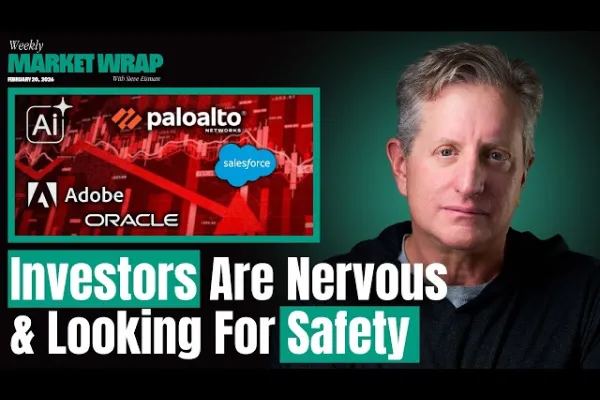
Flight to Safety, Private Credit Stress, and the Brewing Life Insurance Risk
Beneath a Flat Market: Stress Is Building
The headline number says the market is flat year to date.
But underneath, the market is rotating aggressively — and that rotation is revealing fear.
We are seeing a shift from performance chasing to flight to safety.
Here’s what that looks like:
The S&P 500 Information Technology sector is down 4% YTD.
The software sub-sector is down 20% YTD.
Meanwhile, consumer staples are up 13%.
That is not normal leadership rotation.
That is defensive positioning.
Tech has driven the bull market for years. When software collapses while staples rally — without a recession — investors are sending a signal.
They are nervous.
The irony? Staples fundamentals have not materially improved. Inflation and tariffs still pressure margins. Yet money is moving there anyway.
That’s psychology, not fundamentals.
Private Credit: The Duration Mismatch Problem
This week brought negative news from the private credit world.
Reports surfaced that Blue Owl restricted withdrawals from one of its private credit funds.
Investors can no longer redeem quarterly. Capital will now be returned only through:
actual loan repayments
asset sales
This should surprise no one.
Private equity firms have spent years selling private credit funds to retail investors. The structure contains a fundamental flaw:
Investors can redeem quarterly.
The loans are long-term and illiquid.
That is a classic duration mismatch.
Duration mismatches always create problems.
It destroyed the savings and loan industry in the 1980s.
When retail investors get nervous and demand liquidity, but the assets cannot be liquidated, redemption gates follow.
Do not be surprised if other private credit funds suspend redemptions in the coming months.
This story is not over.
Acquisition News: Warner Bros, Paramount, and Homebuilders
Warner Bros. reopened negotiations with Paramount.
My view: the winner may be whoever does not get Warner Bros.
The company carries cultural dysfunction and questionable valuation at $70 billion.
If Netflix loses out, that could paradoxically make the stock more attractive.
In housing, Tri Pointe Homes (TPH) agreed to be acquired by Sumitomo Forestry at 1.3x tangible book value.
That reinforces the value case for small-cap homebuilders.
Meritage Homes, which I previously discussed, still trades near tangible book value.
This is not a buyout thesis — but external validation matters.
Nvidia and the AI Spend Question
Nvidia reports next week.
With hyperscalers committing roughly $650 billion in AI capex for 2026 — up from $450 billion in 2025 — it is difficult to imagine weak numbers.
The real question is not earnings.
The question is whether the market still cares.
When narratives turn negative, even strong results may not rescue sentiment.
Software: A Bloodbath Regardless of Results
The narrative around software is brutal.
Stocks are declining on:
good earnings
mixed earnings
bad earnings
Palo Alto Networks reported:
Revenue up 15%
EPS up 27%
Beat expectations
But mixed guidance led to a 6% after-hours drop.
There is zero tolerance for uncertainty in software right now.
The AI narrative has morphed from growth driver to moat destroyer.
Payments: Only Visa and Mastercard Survive
Payments continue consolidating into two long-term winners:
Visa
Mastercard
Everything else increasingly looks like a trading vehicle.
Global Payments jumped 16% on earnings, largely short covering.
But revenue growth is 5%.
The stock is still down 24% over 12 months.
That is volatility, not structural value creation.
Moody’s vs S&P: Proprietary Data Matters
Moody’s delivered strong results and emphasized its proprietary databases.
The stock rose 6.5%.
Contrast that with S&P, which faced AI-franchise fears.
When a company owns unique, irreplaceable data, AI disruption becomes much harder.
Duopolies with proprietary assets remain powerful.
(Full disclosure: I own Moody’s.)
Carvana: The Danger of Shorting Meme Stocks
Carvana:
Beat revenue
Missed earnings
Stock fell 20% after hours
Then recovered, closing down only 8%
11% of the float is short.
Three days to cover.
This is why heavily shorted stocks are dangerous — even when the fundamentals disappoint.
Walmart: Consumer Stress Is Real
Walmart beat revenue and EPS.
But guidance disappointed:
2026 EPS guidance implies only 6% growth
Same-store sales guidance at 4%
Walmart trades at 50x forward earnings.
Why?
Scarcity value.
Traditional retail has been devastated by e-commerce. The few survivors command premium multiples.
Even weak guidance couldn’t significantly hurt the stock.
That tells you positioning remains defensive.
Utilities and AI Infrastructure: Quanta Services
Quanta Services (PWR), an engineering firm tied to utility construction and AI power scaling, reported:
Revenue up 20%
Strong guidance
AI data centers require massive power infrastructure upgrades.
This remains one of the more durable AI-adjacent plays.
(Full disclosure: I own it.)
Mailbag: Recession, Sector Rotation, Life Insurance, Technical Analysis
Would a Recession “Fix” the K-Shaped Economy?
I am not rooting for a recession.
But retail investors have been trained to buy every dip.
That behavior only stops after an actual recession causes real economic pain.
Recessions:
expose weak balance sheets
force liquidations
reset valuations
push retail investors to the sidelines
The Fed then lowers rates.
The economy eventually resets healthier.
We haven’t had a true cleansing recession since the Great Financial Crisis.
But I do not yet see enough signals to predict one.
Where Does Money Go in a Recession?
Historically:
Money flows from growth and cyclicals into staples:
Consumer staples
Utilities
Healthcare
Real estate
But this cycle is complicated.
Utilities are AI beneficiaries — vulnerable if AI slows.
Healthcare insurers face rising medical cost pressures.
In a recession today, I would favor:
Consumer staples
Traditional utilities like Consolidated Edison
Property & casualty insurers (Chubb, Travelers, Progressive)
Not all “defensive” sectors are equal this time.
The Brewing Life Insurance Risk
Two readers raised concerns about private equity-owned life insurers.
This is an important issue.
There is a massive potential problem brewing in the life insurance sector.
It involves:
increasing investment risk
hidden leverage
aggressive asset allocation
annuity liability growth
Private equity firms have acquired life insurers and are using them as asset-gathering vehicles.
The concern:
Policyholders believe they are buying safety.
But insurers may be reaching for yield.
This is a complex story.
On March 9th, I will release an in-depth interview with a forensic accountant and former life insurance examiner who explains what is actually happening.
It is worth watching.
Technical Analysis: My View
Technical analysis, to me, reflects investor psychology.
Charts show:
love
hate
indifference
I do not rely on technicals exclusively.
But I always consult them.
I will not buy a stock whose chart has collapsed.
After a major decline, I wait for base-building.
Technical analysis is a tool.
It is not a substitute for fundamental analysis.
Final Thought
The market looks calm on the surface.
Underneath:
software is collapsing
private credit is cracking
consumer stress is visible
life insurance risk may be building
defensive sectors are outperforming
When money rotates this aggressively without a recession, it is worth paying attention.
Flat indices can hide serious internal stress.
And that’s the wrap.
Thanks for reading this week’s wrap.
If you’d like to catch my interviews and market breakdowns, visit The Real Eisman Playbook or subscribe to the Weekly Wrap channel on YouTube.
This post is for informational purposes only and does not constitute investment advice. Please consult a licensed financial adviser before making investment decisions.


