George Noble vs. The Consensus: Gold, Energy, AI Skepticism, and the Case Against Tesla
This week’s conversation wasn’t with a strategist or economist.
It was with a veteran portfolio manager.
George Noble has been investing since 1981. He ran one of the largest funds at Fidelity, launched hedge funds, lived through multiple cycles, and has experienced both spectacular success and painful failure.
His message is clear:
This is not a “buy the index and forget it” market.
He believes 2026 is shaping up as a rotation-driven, stock-picker’s market — one that punishes consensus and rewards dispersion.
Let’s break down his core themes.
1. The Big Rotation: Out of Tech, Into Resources
Noble’s macro framing is simple:
Not recession.
Rotation.
Reflation.
He argues that money is moving out of mega-cap tech and into:
Energy
Materials
Precious metals
Select foreign markets
He believes growth is no longer scarce. And when growth becomes more abundant, investors stop paying extreme multiples for concentrated tech exposure.
His tactical expression:
Long energy (XLE), short tech (XLK)
He views this as early innings of a longer-term capital reallocation.
2. The Gold Debate: Debasement vs. Dollar Dominance
Noble is unapologetically bullish on gold.
His thesis:
Fiat currencies are being debased.
Fiscal deficits are unsustainable.
Eventually, bond markets will revolt.
He points to:
Rising global fiscal stress.
Japan’s bond market volatility.
Political pressure for lower rates despite high deficits.
The counterargument:
The U.S. Treasury market remains the backbone of the global financial system. There is no true alternative reserve asset.
This tension defines the gold debate:
Noble sees structural risk.
Eisman sees institutional inertia and lack of alternatives.
Gold may continue rising without requiring dollar collapse — but that remains the dividing line.
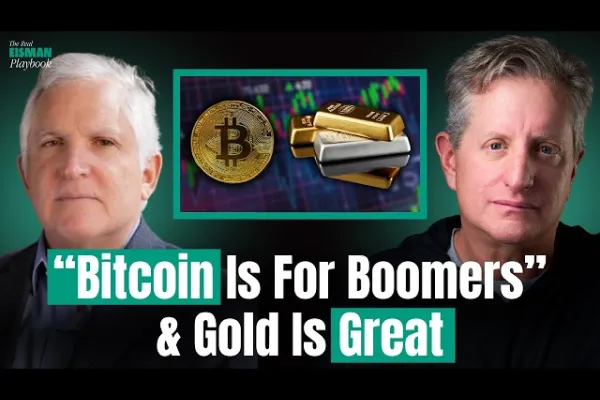
3. Bitcoin: “For Old People”
Both investors align here.
Bitcoin was marketed as digital gold.
But behaviorally, it acts like:
A risk asset.
A speculative vehicle.
A volatility trade.
When inflation fears rise, Bitcoin often falls.
When tech rallies, Bitcoin rallies.
That contradicts its own thesis.
Noble adds a cultural twist:
Younger speculators have migrated to zero-day options, prediction markets, and sports betting platforms like FanDuel and DraftKings.
His blunt framing:
Bitcoin is now the Facebook of speculation — for boomers.
He is outright bearish on crypto and short Strategy (formerly MicroStrategy), which remains highly leveraged to Bitcoin’s price.
4. Tesla: Valuation vs. Narrative
Noble’s Tesla thesis centers on three disconnects:
1. Revenue Decline
2026 may be the third consecutive year of declining revenue.
2. Earnings Collapse
Peak EPS (~$4.50 in 2022) has fallen to roughly $1.70.
That normally destroys growth stock valuations.
3. Market Cap Disconnect
Tesla trades around $1.3–$1.4 trillion.
Yet:
Waymo’s valuation suggests robo-taxi economics are far smaller.
Robotics revenue is speculative.
Core auto business faces margin pressure and slowing demand.
His concern:
Tesla may face cash flow stress as capex rises for autonomous and robotics projects.
However:
Shorting cult stocks is dangerous.
Even when fundamentals deteriorate, narratives persist.
5. AI: The Dot-Com Parallel
Noble is skeptical of AI infrastructure spending.
He doesn’t deny AI’s utility.
He questions monetization.
His argument echoes concerns raised by Gary Marcus:
Capital spending may be misallocated.
AI pricing may be too low relative to cost.
Productivity gains may not translate into corporate profitability.
Valuations assume exponential revenue scaling that may not materialize.
Historical parallel:
The internet changed the world — but most dot-com investors were destroyed.
AI could follow the same pattern:
Transformative technology, poor investor returns.
6. Energy: The Under-Owned Trade
Energy is just 3% of the S&P 500.
Institutional investors structurally underweight it due to:
Benchmark constraints
ESG pressure
Market cap concentration in tech
Noble prefers:
Offshore drilling and services
Schlumberger
Tidewater
Select oilfield service plays
His thesis:
If reflation persists and capital rotates, energy could experience multi-year re-rating.
7. Open Door: Accounting Illusions
Open Door, a house-flipping platform, is another target.
The key issue:
Gross revenue accounting vs. economic revenue.
If Open Door buys a house for $500,000 and sells it for $505,000:
GAAP revenue = $505,000
Economic profit = $5,000
Using EV-to-sales without adjusting for this distorts valuation.
Retail investors focusing on surface metrics misunderstand the business model.
Noble sees it as a speculative meme stock detached from fundamentals.
8. Active Management’s Potential Comeback
Perhaps the most important structural takeaway:
If mega-cap tech stops dominating returns,
active managers may finally outperform after a decade of underperformance.
This requires:
Dispersion
Sector rotation
Valuation mattering again
If capital reallocates meaningfully from tech into cyclicals and resources, stock picking regains relevance.
Final Perspective
Where do they agree?
Skepticism on crypto.
Tesla valuation disconnect.
AI monetization questions.
Growing market dispersion.
Where do they differ?
Gold and dollar sustainability.
Severity of fiscal risk.
Immediacy of bond market stress.
The key variable remains the 10-year Treasury.
If yields spike meaningfully above 5%, Noble’s thesis gains force.
If yields remain contained, the rotation may be slower and more nuanced.
Bottom Line
George Noble is making a clear call:
Rotate out of tech.
Own energy and materials.
Be skeptical of AI euphoria.
Avoid crypto.
Question extreme growth valuations.
It’s a contrarian stance relative to the last five years.
Whether he’s early — or finally right — depends on how this rotation evolves.
The dispersion has begun.
Now we see how deep it goes.
Until next time, this is Steve Eisman, and this has been The Real Eyes Playbook. .
If you’d like to catch my interviews and market breakdowns, visit The Real Eisman Playbook or subscribe to the Weekly Wrap channel on YouTube.
This post is for informational purposes only and does not constitute investment advice. Please consult a licensed financial adviser before making investment decisions.


