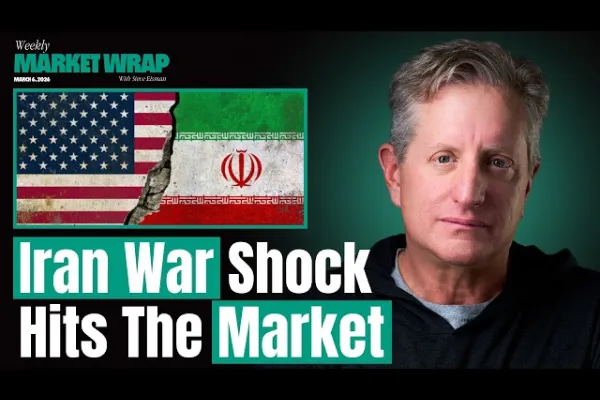
War With Iran, Oil Shock Risks, and the Global Energy Crisis
Markets Are Trading the War, Not Fundamentals
During normal times, markets price assets based on expected future earnings and cash flows.
But in periods of geopolitical crisis, traditional valuation frameworks break down.
Instead, markets react almost entirely to headlines.
Right now, the global market is focused on a single issue: the war involving Iran.
Investors are reacting to every development in real time.
At the start of the week, oil prices surged above $100 per barrel as fears of supply disruption intensified. Equity markets fell sharply as energy prices spiked.
Later that same day, comments suggesting the conflict might end soon pushed oil prices below $90, triggering a rally in stocks.
This kind of volatility reflects extreme uncertainty. Until there is clarity about the trajectory of the conflict, markets will continue to move based on geopolitical news rather than economic fundamentals.
Oracle Earnings and the AI Narrative
Outside of the geopolitical crisis, one major earnings report stood out during the week.
Oracle reported strong quarterly results.
The company delivered earnings per share of $1.79, beating expectations of $1.70, while revenue reached $17.19 billion, exceeding estimates of $16.91 billion.
Revenue grew an impressive 22% year over year, and the company raised its guidance for the upcoming quarter.
Despite this strong performance, Oracle’s stock remains significantly below its peak.
The company has lost more than 50% of its value since October, largely because investors worry about the financial burden of AI infrastructure spending.
Unlike larger technology companies such as Google or Microsoft, Oracle must finance much of its AI expansion with debt rather than internal cash flow.
As a result, investors remain cautious about the company’s balance sheet even as demand for AI services grows.
Why the Strait of Hormuz Matters
The most important economic risk from the war involves the Strait of Hormuz.
This narrow shipping channel is one of the most critical energy choke points in the world.
Normally, between 60 and 100 oil tankers pass through the strait each day, transporting crude oil and liquefied natural gas from the Middle East to global markets.
Currently, shipping activity has slowed dramatically.
While some ships are still moving through the region, traffic has fallen far below normal levels. In practical terms, the strait has become a bottleneck for global energy flows.
If the disruption continues, the consequences could be severe.
Oil Supply Is Already Being Shut In
The energy market is facing another problem beyond shipping disruptions.
Several oil-producing countries in the Middle East are being forced to shut down production because they cannot export their output.
When oil cannot be shipped, producers must store it. Once storage capacity is full, production must stop.
Countries like Iraq rely heavily on the Strait of Hormuz to export their oil. Without access to export routes or sufficient storage infrastructure, they have no choice but to halt production.
So far, approximately 6.7 million barrels of oil per day have already been shut in across the region.
While global oil consumption is roughly 103 million barrels per day, even a disruption of several million barrels can have a major impact on prices.
The longer production remains shut down, the greater the risk of long-term supply disruptions.
The LNG Crisis Europe Is Facing
While oil disruptions dominate headlines, natural gas may present an even bigger risk.
Qatar is one of the world’s largest exporters of liquefied natural gas (LNG), and nearly all of its shipments must pass through the Strait of Hormuz.
With shipping disrupted, Qatari LNG exports have effectively stopped.
This poses a significant challenge for Europe.
After reducing its dependence on Russian energy following the invasion of Ukraine, Europe increasingly relied on LNG imports from Qatar, the United States, and Australia.
Without Qatari shipments, European energy markets could face shortages.
Strategic Petroleum Reserves Can Only Help Temporarily
Governments may attempt to offset supply disruptions by releasing oil from strategic reserves.
The United States currently holds about 400 million barrels in its Strategic Petroleum Reserve (SPR).
However, these reserves are limited.
A coordinated release from multiple countries could stabilize markets temporarily, but it would only buy time.
Depending on the scale of the disruption, reserves might cover supply shortfalls for only a few weeks.
After that, physical supply constraints would begin to dominate.
Why Shutting Down Energy Infrastructure Is Complicated
Restarting energy production is far more difficult than shutting it down.
Many energy facilities cannot simply be turned on and off like a light switch.
Oil fields, LNG liquefaction plants, and pipelines involve complex industrial systems that must be carefully cooled, depressurized, and restarted.
If production remains shut down for an extended period, restarting operations can take significant time and technical effort.
This means even a temporary disruption could create longer-term supply problems.
How Long the Crisis Lasts Will Determine the Economic Impact
According to energy analysts, the timeline of the conflict is critical.
If the disruption lasts only a couple of weeks, markets may be able to absorb the shock through stockpile releases and alternative shipping routes.
But if the conflict drags on for months, the consequences could be much more severe.
Energy prices could rise sharply, inflation pressures could increase, and global economic growth could slow.
The Risk of Regional Escalation
Another major concern is whether additional groups in the region become involved in the conflict.
One potential escalation scenario involves the Houthis in Yemen.
So far, they have not entered the conflict.
But if they do, they could target infrastructure in the Red Sea, including pipelines and ports that serve as alternative export routes for Saudi oil.
Such an escalation could further disrupt global energy supply chains.
A Conflict With Unclear Objectives
Another complicating factor is uncertainty about the war’s objectives.
Different political leaders have offered different descriptions of what success might look like.
Some statements suggest limited goals focused on destroying missile infrastructure.
Others suggest broader objectives, including regime change in Iran.
The ambiguity creates uncertainty for markets and for global energy producers.
Historical Lessons From Middle East Conflicts
Analysts studying the region often draw comparisons with past conflicts, particularly the Iraq War.
Initial expectations in that conflict suggested a short and decisive campaign.
Instead, the war evolved into a prolonged and complex engagement.
Many analysts worry about the risk of similar mission creep in the current conflict.
Initial military objectives can expand over time, especially if new developments change the strategic environment.
The Next Two Weeks May Be Critical
Energy analysts emphasize one key timeline.
If the conflict can be contained and de-escalated within the next couple of weeks, global energy markets may stabilize relatively quickly.
But if the disruption continues beyond that timeframe, energy infrastructure shutdowns and supply shortages could intensify.
In that case, the global economy may begin to feel significant pressure from higher energy prices.
Final Thoughts
For now, markets are focused almost entirely on geopolitical developments.
Investors are reacting to headlines rather than earnings reports or economic indicators.
The war with Iran has introduced a level of uncertainty that traditional financial analysis cannot easily account for.
Whether the conflict ends quickly or expands into a prolonged regional crisis will determine how severe the economic consequences ultimately become.
Until then, volatility is likely to remain high across global markets.
Thanks for reading this week’s wrap.
If you’d like to catch my interviews and market breakdowns, visit The Real Eisman Playbook or subscribe to the Weekly Wrap channel on YouTube.
This post is for informational purposes only and does not constitute investment advice. Please consult a licensed financial adviser before making investment decisions.


