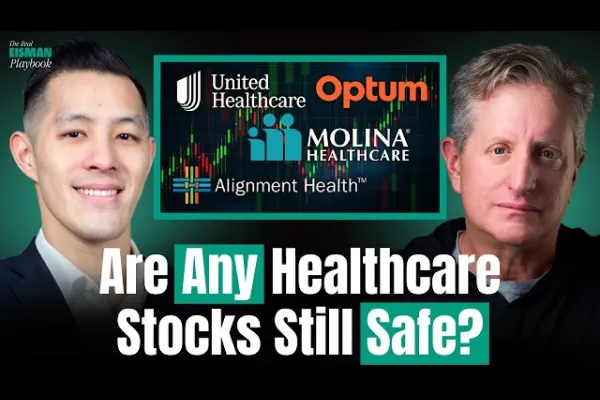
The Managed Care Meltdown: UnitedHealth, Medicaid Chaos, and What Comes Next
A Sector That Went From “Safe Bet” to Systemic Risk
For years, companies like UnitedHealth were considered:
Reliable
Predictable
Long-term compounders
Investors treated them like “buy and forget” assets.
That assumption is now broken.
The managed care sector is undergoing a multi-layered structural failure—not just cyclical weakness.
The Trigger: When Perception Met Reality
The turning point wasn’t just financial—it was reputational.
Rising backlash against claims denials (15–17%)
Public outrage around healthcare access
Political scrutiny intensifying
Initially, investors dismissed it as PR noise.
Then earnings started to crack.
The Core Problem: Optum Is Breaking
The biggest misconception:
UnitedHealth is an insurance company.
It isn’t anymore.
Historically: 90% insurance / 10% Optum
Today: Majority of earnings come from Optum
Optum includes:
Healthcare providers (doctors, clinics)
Pharmacy benefit management (PBM)
Health tech/data
This was supposed to be the growth engine.
Now it’s the weakest link.
Risk Adjustment: The Hidden Leverage That’s Unwinding
The most critical concept in this entire system is:
Risk adjustment
It determines how much insurers get paid based on patient sickness.
What Happened:
Before: Flexible coding → higher reimbursement
After policy changes: Stricter rules → lower reimbursement
The Smoking Gun: Aggressive Coding
A detailed analysis uncovered something alarming:
Pre-acquisition: Risk scores flat (~1.0)
Post-acquisition: Jumped to 1.5 (50% increase)
This implies:
Revenue growth was partly driven by more aggressive coding, not just better care.
Now that rules tightened:
Revenue per patient drops
Margins compress
Earnings collapse
Why This Is Dangerous
Risk adjustment behaves like leverage:
When it rises → profits surge
When it falls → profits collapse
This is exactly what’s happening now.
Optum Health: From Profit Engine to Liability
Margins tell the story:
Previously: ~6% operating margin
Now: -0.8% (negative)
And the response?
Clinic closures
Provider contract terminations
Cost cutting
These are defensive moves, not growth strategies.
The Second Blow: Government Pricing Pressure
Just as coding pressure hit, another shock arrived:
Expected Medicare Advantage rate increase: ~5%
Actual: 0% (flat)
This creates a double squeeze:
Lower revenue per patient
Rising medical costs
And It Gets Worse: New Coding Cuts
Upcoming changes further reduce payments for major conditions:
Lung disease: ↓ ~20%
Kidney disease
Heart disease
These conditions are high-prevalence, high-cost.
Impact:
The sickest patients become less profitable.
The Medicaid Crisis: Molina as Case Study
Medicaid is facing its own structural breakdown.
What Happened:
During COVID:
Enrollment surged (70M → 95M)
Post-COVID:
Eligibility checks resumed
Many removed due to paperwork
The Hidden Effect:
Healthy people dropped off
Sicker population remained
Result:
Costs increased, but pricing didn’t adjust fast enough.
Why Medicaid Is Still Risky
Even though rates will eventually adjust:
Timeline: 24–36 months
Meanwhile: Costs continue rising
And a new risk is coming:
Work Requirements (2027)
Must prove employment
More administrative churn
Likely outcome:
More healthy members exit
Risk pool worsens further
The Structural Failure of Vertical Integration
On paper, companies like UnitedHealth should dominate:
Insurance
Providers
Pharmacy
Technology
This is full vertical integration.
So why are they failing?
The Real Issue: Integration ≠ Coordination
UnitedHealth has:
2,700+ subsidiaries
Fragmented systems
Poor data interoperability
This leads to:
No unified care model
No real efficiency gains
Massive operational complexity
They are vertically integrated—but not functionally integrated.
The Alternative Model: Alignment Health
While incumbents struggle, smaller players are executing better.
Alignment Health shows what works:
Denial rate: <2% vs industry 15–17%
Hospitalizations: significantly lower
100% members in high-quality plans
Their advantage:
Modern tech stack
Unified data system
Focus on high-risk patients early
Result:
Lower costs + better care + higher growth
PBMs: The Hidden Profit Engine
Pharmacy Benefit Managers (PBMs) sit in the middle of drug pricing.
They:
Negotiate rebates
Control formularies
Extract multiple fee layers
Key insight:
Rebates don’t reduce prices—they often increase them.
Even if rebates disappear:
PBMs have 30–40 alternative revenue levers
Profitability may persist
This makes the system:
Opaque
Hard to regulate
Structurally inefficient
The Big Picture: A System Under Stress
Three major forces are colliding:
1. Policy Pressure
Risk adjustment tightening
Medicare pricing constraints
Potential regulation (PBMs, breakups)
2. Structural Complexity
Fragmented systems
Failed integration
Operational inefficiency
3. Economic Reality
Rising medical costs
Mispriced risk
Margin compression
Investment Takeaway
This is not a temporary downturn.
It’s a structural reset.
Near-Term:
Continued earnings pressure
Volatility across the sector
Medium-Term:
Medicaid recovery (2027–2029)
Selective opportunities
Long-Term:
Winners will be:
Tech-enabled
Clinically efficient
Less dependent on financial engineering
Final Insight
The most important realization:
The healthcare system optimized for financial extraction, not clinical efficiency.
That model is now breaking.
The next generation of winners will not be:
Bigger
More integrated
They will be:
More coherent, more data-driven, and more aligned with actual patient outcomes.
Until next time, this is Steve Eisman, and this has been The Real Eyes Playbook. .
If you’d like to catch my interviews and market breakdowns, visit The Real Eisman Playbook or subscribe to the Weekly Wrap channel on YouTube.
This post is for informational purposes only and does not constitute investment advice. Please consult a licensed financial adviser before making investment decisions.


