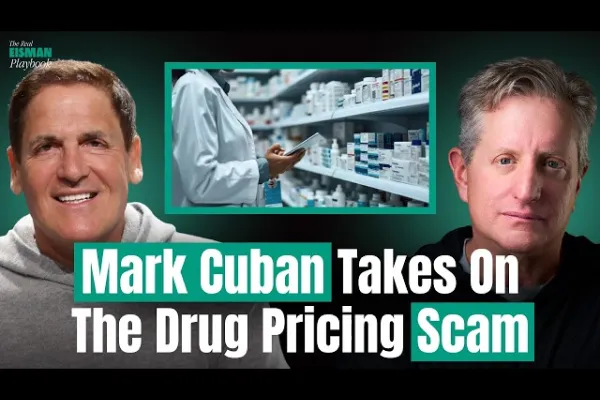
Mark Cuban on Drug Pricing, PBMs, and Fixing Healthcare Costs
The Problem With Drug Prices in the United States
The United States healthcare system has a fundamental problem: almost everyone trusts their doctors, but almost nobody trusts the economics of healthcare.
Patients rarely know what their treatment or medication will cost ahead of time. Instead, they receive prescriptions or medical care and only discover the cost afterward.
This lack of transparency has created a system where millions of Americans live in fear of medical bills. Many people end up with large amounts of medical debt, while others are forced to ration medication or skip treatment entirely because they cannot afford it.
One of the most extreme examples of this problem is prescription drug pricing.
In many cases, Americans pay far more for the same medications than people in other countries.
Entrepreneur Mark Cuban believes the system is fundamentally broken—and he created Cost Plus Drugs to challenge it.
The Cost Plus Drugs Model
Cost Plus Drugs operates with a simple philosophy: transparency and predictable pricing.
The company sells medications using a straightforward formula:
Drug cost + 15% markup + shipping
When customers visit the website, they see the exact wholesale cost of a medication and the markup applied to it. There are no hidden pricing structures, no rebates, and no opaque negotiations.
The result can be dramatic.
Some medications that cost thousands of dollars annually through traditional channels can cost only a fraction of that amount through Cost Plus.
For example, certain biosimilar drugs that may cost tens of thousands of dollars per year elsewhere can be purchased through Cost Plus for just a few hundred dollars.
The company currently focuses mostly on generic drugs and biosimilars, though it has begun expanding into brand-name medications as well.
Why Healthcare Costs Are So Confusing
To understand why prescription drugs are so expensive in the United States, it is necessary to understand the system that controls pricing.
One of the most important players is the pharmacy benefit manager, or PBM.
PBMs are companies that manage prescription drug benefits for health insurance plans. Their responsibilities include:
Determining which drugs insurance plans cover
Setting patient pricing during deductible and copay phases
Negotiating prices with pharmaceutical manufacturers
Processing pharmacy claims
On the surface, this sounds like a useful function.
But the system becomes far more complicated—and problematic—because of how PBMs make money.
The Rebate System That Drives Up Drug Prices
A key part of the drug pricing system involves rebates.
Here is how the process typically works.
A pharmaceutical company sells a drug with a list price—known as the wholesale acquisition cost (WAC).
In the United States, this wholesale price often functions as the retail price paid by patients.
PBMs then negotiate rebates with drug manufacturers in exchange for placing those drugs on their insurance formularies.
A formulary is essentially the list of medications an insurance plan agrees to cover.
If a drug is not included on the formulary, patients may have to pay the entire cost out of pocket. This makes formulary placement extremely valuable for pharmaceutical companies.
As a result, drug manufacturers often pay large rebates to PBMs to secure favorable placement.
But the critical issue is this:
The rebates usually do not go to the patient.
Instead, the rebate money flows through multiple intermediaries.
Some of it may go to employers or insurance plans, but a portion is often retained by the PBM itself or related organizations.
Meanwhile, patients—especially those with high deductibles—often pay the full list price of the drug.
This means the sickest patients effectively fund the rebate system.
Why Deductibles Make the System Worse
Another structural problem involves insurance deductibles.
Many Americans now have high-deductible health plans, sometimes requiring several thousand dollars in out-of-pocket spending before insurance coverage begins.
During this deductible phase, patients must pay the full price of medications.
If a drug costs $1,000 and the patient has not yet met their deductible, they must pay the entire $1,000—even if the PBM receives a $400 rebate from the manufacturer.
For patients who cannot afford these costs, the result can be devastating.
Some people stop taking medications entirely because they cannot pay for them.
Others take smaller doses or delay prescriptions to stretch their supply.
In extreme cases, this can lead to serious health consequences.
Hospitals as “Subprime Lenders”
High deductibles have also transformed hospitals into something unexpected: lenders.
When patients cannot afford their deductible but require treatment, hospitals often arrange financing options or payment plans.
This effectively turns healthcare providers into lenders extending credit to patients who may have little ability to repay.
Hospitals accept this risk because they want to access the larger insurance reimbursement that comes after the deductible is paid.
But the system creates financial strain for both providers and patients.
Why PBMs Have So Much Power
One reason PBMs dominate the system is that they control access to massive numbers of patients.
Large PBMs may represent tens of millions of covered individuals.
If a pharmaceutical company refuses to pay rebates or cooperate with PBM negotiations, their drug may be excluded from the formulary entirely.
In practical terms, this means the drug becomes almost impossible to prescribe.
As a result, pharmaceutical companies often feel they have no choice but to participate in the rebate system.
Adding to the complexity, many PBMs are owned by large insurance companies.
These corporations often operate highly integrated healthcare ecosystems that include:
Insurance plans
PBMs
Pharmacy networks
Healthcare providers
Some of the largest insurance companies have thousands of subsidiaries and enormous internal financial flows.
How Cost Plus Drugs Challenges the System
Cost Plus Drugs attempts to disrupt this system by removing many of the intermediaries involved in drug pricing.
Instead of negotiating with PBMs or participating in rebate arrangements, the company sells medications directly to consumers at transparent prices.
The company also publishes its entire pricing structure publicly—something almost unheard of in the pharmaceutical industry.
Customers pay the same price regardless of:
Insurance status
Location
Negotiated contracts
Prices change only when the underlying drug cost changes.
As purchasing volume increases, costs often fall—and those savings are passed directly to customers.
Why Some Drug Companies Won’t Work With Cost Plus
Despite the benefits of the model, not every pharmaceutical manufacturer is willing to sell through Cost Plus Drugs.
According to Cuban, many companies fear retaliation from large PBMs and insurers.
If a drug manufacturer partners with Cost Plus and bypasses the traditional pricing structure, PBMs could potentially remove that manufacturer’s products from insurance formularies.
Because formularies control access to tens of millions of patients, losing that placement could significantly harm a drug company’s business.
As a result, some pharmaceutical firms hesitate to participate—even if they support the transparency model.
A Second Initiative: Cost Plus Wellness
In addition to pharmaceuticals, Cuban has launched another initiative called Cost Plus Wellness.
This program focuses on healthcare provider contracts.
Rather than working through traditional insurance systems, Cost Plus Wellness negotiates direct contracts with hospitals and medical providers.
These contracts eliminate many of the administrative costs associated with insurance claims, including:
Pre-authorizations
Denials
Delayed payments
Complex billing disputes
Hospitals receive guaranteed payment at agreed prices, while employees receive care with little or no out-of-pocket cost.
Cuban has also published these contracts publicly, allowing other employers to replicate the model.
The goal is to create an open-source approach to healthcare contracting.
Can This Model Scale?
Cost Plus Drugs has grown rapidly since its launch in early 2022.
The company now offers thousands of medications and serves millions of patients.
As volume increases, the company continues to negotiate lower drug costs and expand its offerings.
Beyond retail prescriptions, the company is also investing in drug manufacturing and specialty therapies, including treatments for rare diseases.
If these efforts succeed, Cuban believes the company could generate billions in annual revenue within the next several years.
The Larger Goal: Transparency
At its core, the mission of Cost Plus Drugs is simple.
The company wants to introduce transparency into an industry where pricing is often hidden behind complex negotiations and intermediaries.
In most industries, consumers can compare prices easily.
Healthcare in the United States is one of the few sectors where that basic transparency does not exist.
Cuban’s argument is that when pricing becomes visible, competition will naturally drive costs down.
Final Thoughts
The U.S. healthcare system is one of the most complex industries in the world.
Drug pricing alone involves pharmaceutical companies, wholesalers, PBMs, insurers, employers, pharmacies, and healthcare providers.
Each layer introduces additional incentives and financial arrangements that often obscure the true cost of care.
Mark Cuban’s approach attempts to simplify the system by eliminating many of those layers.
Whether Cost Plus Drugs ultimately reshapes the industry remains uncertain.
But by publishing prices and offering a straightforward pricing model, it has already introduced something the healthcare system has long lacked:
Transparency.
Until next time, this is Steve Eisman, and this has been The Real Eyes Playbook. .
If you’d like to catch my interviews and market breakdowns, visit The Real Eisman Playbook or subscribe to the Weekly Wrap channel on YouTube.
This post is for informational purposes only and does not constitute investment advice. Please consult a licensed financial adviser before making investment decisions.


