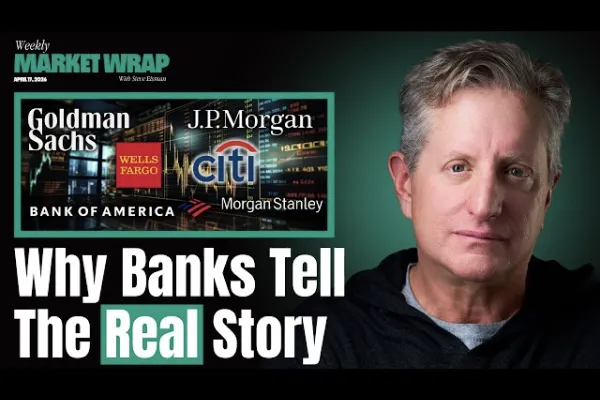
Markets, War, and Credit Cycles: What Investors Are Missing Right Now
Introduction
Right now, three forces are shaping markets simultaneously:
Geopolitical tension (Iran conflict)
Bank earnings and credit signals
Early cracks in private credit
Individually, each matters.
Together, they tell a much more important story:
The market is pricing optimism… while risk is quietly building underneath.
Let’s break this down clearly.
1. The Iran Situation: Markets Are Trading Hope, Not Reality
Over the weekend, talks between the US and Iran collapsed.
Instead of escalating militarily, the US shifted strategy:
Blocking the Strait of Hormuz
Applying economic pressure instead of direct conflict
Immediate market reaction:
Oil spiked above $100
Then quickly dropped
Stocks rallied
Why?
Because the market believes this will resolve quickly.
That belief—not facts—is driving price action.
And that’s dangerous.
The core dynamic:
Markets don’t need good news.
They just need:
No escalation
Some path to resolution
As long as that narrative holds, markets stay elevated.
2. The Bigger Risk: Markets Are Assuming a Fast Resolution
Despite uncertainty, major indices are already at highs:
S&P 500 → back to record levels
Nasdaq → also at highs
This implies:
The market is pricing in a short-lived conflict.
But here’s the issue:
The conflict is unresolved
Economic pressure strategies take time
Outcomes are uncertain
So the real question is:
What happens if this doesn’t end quickly?
That’s where volatility returns.
3. Banks Just Gave Us a Reality Check
While headlines focus on war, the real signal came from banks.
Why banks matter:
They lend across the entire economy
They see stress before anyone else
They are real-time indicators of economic health
As the banks go, so goes the economy.
4. Credit Data: Surprisingly Stable (For Now)
Key insight from major banks:
Credit quality is still benign
No broad deterioration yet
No signs of systemic stress
Examples:
JP Morgan: non-accrual loans stable to slightly down sequentially
Bank of America: flat to improving credit metrics
This tells us:
The feared credit cycle has NOT started yet.
Important nuance:
There are issues (especially in private credit and software)
But they are still isolated
5. The 17-Year Illusion
We’ve had:
17 years of extremely strong credit conditions
That’s abnormal.
And investors are starting to ask:
Is this streak ending?
Are we entering a real credit cycle?
Right now:
Data says no—but sentiment says maybe.
That gap is where markets get fragile.
6. Private Credit: The Quiet Risk Building
This is where things get interesting.
Known issues:
Overexposure to software
AI disrupting business models
Increasing uncertainty in valuations
But here’s the key:
Problems exist—but they haven’t spread yet.
Banks show:
Exposure exists
But losses are not material (yet)
Example:
Large banks have tens of billions in exposure
But strong cushions (~40% buffers in some cases)
So we’re in a transition phase:
Not crisis
Not clean either
7. Why the Economy Still Looks Strong
Despite all concerns:
Credit is stable
Banks are profitable
Lending continues
Conclusion:
The US economy is still fundamentally strong.
But with an important caveat:
It’s a K-shaped economy
Some sectors → thriving
Others → under pressure
So:
No recession signal yet
But uneven conditions beneath the surface
8. Bank Earnings: What Actually Mattered
Broad pattern:
Strong performers:
Investment banking + trading-heavy banks
Goldman Sachs
Morgan Stanley
JP Morgan
Why:
Trading volatility = revenue
Advisory rebound
Weaker performers:
Lending-focused banks
Wells Fargo
Bank of America
Why:
Net interest margins under pressure
Lending is highly competitive
Key insight:
Lending is becoming less profitable long-term.
9. Valuation Insight Most People Miss
Simple rule:
Higher returns = higher valuation multiples
So:
Capital markets banks → higher multiples
Lending-heavy banks → lower multiples
Why?
Because:
Lending is commoditized.
Capital markets are not.
This structural difference explains:
Why some banks rerate higher
And others stay stuck
10. The Real Takeaway: Markets Are Calm, But Fragile
Let’s zoom out.
What markets are doing:
Ignoring geopolitical risk
Ignoring early credit cracks
Pricing continued stability
What reality shows:
War unresolved
Private credit stress building
Long-term credit cycle risks emerging
So we’re in a classic setup:
Stability on the surface
Fragility underneath
Final Conclusion
Right now, nothing is breaking.
But multiple systems are being tested at the same time:
Geopolitics
Credit markets
AI-driven disruption
And historically:
Major shifts don’t start with collapse.
They start with subtle cracks.
We’re in that phase.
The smart move isn’t panic.
It’s awareness.
Because when the shift happens:
It won’t feel gradual
It will feel sudden
Thanks for reading this week’s wrap.
If you’d like to catch my interviews and market breakdowns, visit The Real Eisman Playbook or subscribe to the Weekly Wrap channel on YouTube.
This post is for informational purposes only and does not constitute investment advice. Please consult a licensed financial adviser before making investment decisions.


