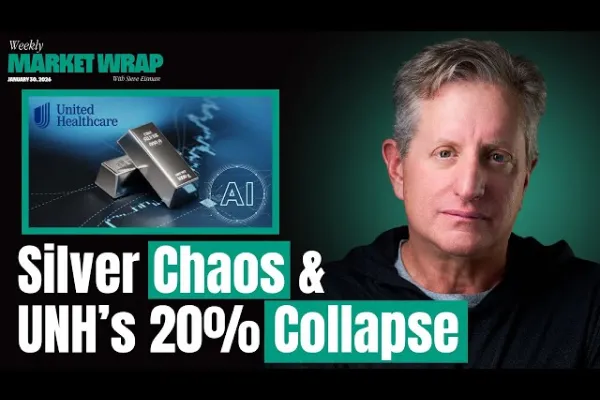
Silver’s Shock, Healthcare’s Collapse, and a Market Searching for Breadth
A Calm Market Hiding Deep Stress
January is over, and it already feels like a full year.
On the surface, markets look calm. Equities finished the month up roughly 1.5%. Long-term Treasury yields remain stuck in a narrow range they’ve occupied for more than three years. The VIX sits near 17, well below panic levels.
Ordinarily, this combination would signal investor complacency.
But underneath that calm sits a profound contradiction. Equity investors are optimistic, yet another cohort of investors is actively hedging against currency debasement and fiscal excess. That tension explains why stocks can rally at the same time gold and silver surge.
Gold has broken above $5,000. Silver, however, is telling a much stranger and more urgent story.
Why Silver Exploded in a Month
Silver closed 2025 near $72 an ounce. By the end of January, it was around $115. A roughly 60% move in a single month.
This is not just speculation.
Most commodity markets function on an implicit assumption: traders will not demand physical delivery of what they own on paper. Silver is an extreme example. Estimates suggest there are over 200 ounces of paper silver for every ounce of physical metal.
That assumption just broke.
On January 1, China reclassified silver as a strategic material, placing it alongside rare earths. Exporting silver now requires special licenses. This matters because China controls roughly 60% of global refined silver supply.
The result is panic. Traders are demanding physical delivery instead of rolling contracts. That has pushed silver into backwardation, where spot prices trade above future prices. Backwardation is rare and signals acute scarcity. Buyers want metal now, not promises later.
This story is not over.
Retail Investors Keep Buying Every Dip
During last week’s Greenland-driven selloff, institutional investors were net sellers. Retail investors, meanwhile, were aggressive buyers via ETFs and index funds.
This pattern has repeated for years. Every dip is bought by retail. That psychology has been reinforced by outcomes.
I remain convinced only an actual recession—not fear of one—will break that reflex. Until then, resilience persists.
Consumer Staples Expose the Lower K
Before earnings season hit full stride, two consumer staples companies offered an early warning.
Procter & Gamble reported zero organic sales growth and a 1% decline in volume. McCormick & Company missed on earnings and showed broad weakness.
This is the lower half of the K-shaped economy. Inflation-weary consumers are trading down, delaying purchases, and searching for value.
Ironically, consumer staples stocks have rallied off their lows despite weak fundamentals. Along with energy, materials, and industrials, staples are among the best-performing sectors this year.
This could be a dead-cat bounce. Or it could be the market anticipating broader economic participation as fiscal stimulus begins to hit.
UnitedHealthcare: A Turnaround That Isn’t
The most consequential earnings story this week belonged to UnitedHealth Group—and it was ugly.
Before the company even reported, the Trump administration announced Medicare Advantage pricing for 2027 would rise just 0.09%. Investors had been expecting something closer to 5%.
Health insurance stocks sold off immediately.
Then UnitedHealthcare reported.
Earnings per share were down 41% year over year. Revenue guidance for 2026 came in far below expectations. But the real problem is structural.
United’s traditional insurance business faces rising medical costs but can reprice relatively quickly. That part is fixable.
The real issue is Optum Health, the company’s growth engine. Changes to Medicare reimbursement have crushed margins. Optum barely made money in the fourth quarter. A 6% pricing headwind is already baked into 2026, and now 2027 pricing is flat.
Given United’s history as an aggressive coder, flat pricing may be optimistic. Estimates for 2027 earnings look wildly unrealistic and will almost certainly be revised down.
The stock fell 20% in a single day.
This was not a leaky roof. This is a house that needs to be stripped to the foundation.
The Cost of Index Blindness
Tuesday was a good day for markets. The S&P 500 and NASDAQ were up. The Dow was down.
Why? UnitedHealthcare is a Dow component.
Index investors often do not realize what they own. Concentration cuts both ways.
Other Earnings That Mattered
Starbucks missed on earnings but posted positive same-store sales growth for the first time in years. That metric mattered more than the miss.
GE Vernova reported orders up 65% year over year. Power remains the binding constraint on AI, and only three firms globally build large gas turbines.
Amphenol delivered explosive growth but disappointed on guidance, reminding investors that expectations now matter more than results.
Meta Platforms showed how fast narratives can flip. Massive AI capex was forgiven once revenue growth surprised to the upside.
ServiceNow delivered strong numbers and still fell 10%. The software sector remains trapped in a narrative that AI will erode moats.
Microsoft beat earnings but declined as investors fixated on AI concentration risk tied to OpenAI.
Tesla remains valued almost entirely on future promises of robotaxis and robotics. Execution, not earnings, will decide the stock.
Apple delivered across the board, with iPhone revenue up 23% and China sales surging 38%.
A Market in Transition
The early signs of 2026 suggest something different from 2025.
Leadership may be broadening. Energy, materials, and industrials are outperforming. Consumer staples are catching bids despite weak demand. Tech narratives are fragmenting.
At the same time, silver’s backwardation, healthcare’s collapse, and stubborn software skepticism signal unresolved stress.
This market is not complacent. It is conflicted.
And those are often the most dangerous—and interesting—conditions of all.
Thanks for reading this week’s wrap.
If you’d like to catch my interviews and market breakdowns, visit The Real Eisman Playbook or subscribe to the Weekly Wrap channel on YouTube.
This post is for informational purposes only and does not constitute investment advice. Please consult a licensed financial adviser before making investment decisions.


