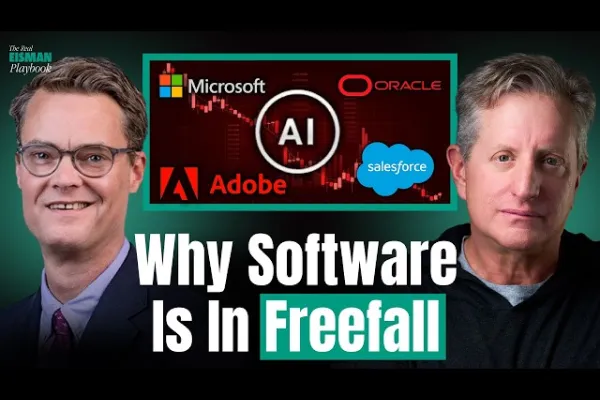
Software Is Breaking: The AI Shock That’s Reshaping a $Trillion Industry
Introduction
For decades, software was the safest bet in tech.
Predictable revenue. High margins. Strong moats. Relentless growth.
Investors didn’t question whether software would win—they only debated which companies would win.
That entire narrative has now collapsed.
Today, software stocks are being sold off indiscriminately. Good results don’t matter. Bad results don’t matter. Nothing seems to matter.
Why?
Because AI has introduced a level of uncertainty the market has never seen before.
1. Why Software Was So Dominant for So Long
To understand the collapse, you first need to understand the strength.
Software companies historically had three massive advantages:
1. Sticky “Systems of Record”
Once a company adopted software like CRM, ERP, or IT systems, switching became painful and risky.
That created extreme customer lock-in.
2. Predictable Revenue (SaaS Model)
With the shift to subscriptions:
Revenue became recurring
Growth became easier to forecast
Investors paid premium valuations
3. Pricing Power
Software companies could raise prices regularly because:
They kept adding features
Customers depended on them
Alternatives were limited
This combination created one of the most powerful investment sectors ever.
2. What Changed: AI Destroyed the Assumptions
AI didn’t just improve software—it challenged the entire model.
The core shift is simple:
The cost of creating software has collapsed.
Today:
You don’t need large teams to build products
Development cycles are dramatically faster
Even non-developers can create applications
This leads to multiple fears:
A. Lower Barriers to Entry
If anyone can build software:
Moats shrink
Competition increases
B. Internal Replacement Risk
Enterprises may stop buying software and instead:
Build custom tools internally
Use AI to replicate functionality
C. Pricing Power Weakens
If software becomes cheaper to build:
Customers will push back on price increases
Margins come under pressure
D. Seat-Based Model at Risk
Most software companies charge per user (“seat”).
But if AI increases productivity:
Companies may need fewer employees
Fewer employees = fewer seats
That directly hits revenue growth.
3. The Biggest Fear: AI Replaces Software Companies Entirely
There’s an even more extreme concern:
What if AI companies bypass traditional software altogether?
Instead of:
Salesforce
ServiceNow
Oracle
You could have:
AI-native platforms directly serving enterprises
This hasn’t happened yet—but the possibility alone is enough to crush valuations.
Because:
Markets price the future, not the present.
4. Why Stocks Are Crashing (Even With Good Results)
This is the most important insight:
Software isn’t being priced on current performance—it’s being priced on uncertainty.
Even companies with:
Strong revenue growth
Clean financials
Solid execution
…are seeing stocks drop.
Because investors are asking:
Will growth slow?
Will pricing power disappear?
Will AI disrupt this business?
And the answer is:
Nobody knows yet.
5. Valuations Have Been Cut in Half
The reset has been brutal:
Price-to-sales multiples: 6.5x → 3.5x
Free cash flow multiples: heavily compressed
Some leaders now trade below market averages
This is unprecedented.
Software used to trade at a premium to the entire market.
Now:
It’s trading at a discount.
6. Why “Cheap” Doesn’t Attract Buyers
Here’s the paradox:
In most sectors, falling valuations attract investors.
Not in software.
Because software investors don’t buy “cheap”—they buy growth and certainty.
And right now:
Growth is uncertain
Pricing is uncertain
Business models are uncertain
So instead of buying dips:
Investors are staying out completely.
7. Not All Software Is Equal: Who Survives?
Despite the chaos, there are clear signals about who might win.
Stronger Positions:
1. Vertical Software Companies
Serve specific industries (e.g., government, healthcare)
Deeply embedded
Harder to replace
2. Data-Driven Businesses
Own proprietary datasets
AI enhances their value rather than replacing it
3. Highly Embedded Enterprise Systems
Complex integrations
Compliance-heavy
Mission-critical
These are harder to disrupt quickly.
At Risk:
1. Generic / Horizontal Software
Easier to replicate
Less differentiation
2. Seat-Based Growth Models
Vulnerable to AI-driven efficiency
3. Companies Dependent on Pricing Power
Likely to face compression
8. The Reality: Nothing Has Broken Yet
This is key:
The fundamentals haven’t deteriorated—yet.
Customers are still renewing contracts
Retention rates remain strong
Businesses are still stable
But markets are forward-looking.
And right now:
Fear is ahead of reality.
9. The Bigger Framework: The Gartner Hype Cycle
This situation fits a classic pattern:
Peak of inflated expectations → “AI will replace everything”
Trough of disillusionment → Reality sets in
Gradual adoption → Winners emerge
We’re currently somewhere between 1 and 2.
Which means:
The real opportunities will come later—not now.
Final Takeaway
Software isn’t dead.
But its old model is.
The industry is moving from:
Predictable → Uncertain
Premium → Discounted
Stable → Transitional
And the biggest challenge is this:
You cannot price what you cannot understand.
Until the market gains clarity on:
AI’s real impact
Pricing power
Growth trajectories
Software will remain under pressure.
The Brutal Truth
Right now, buying software stocks is:
“like catching a falling knife.”
The winners will emerge—but it’s still too early to know who they are.
Until next time, this is Steve Eisman, and this has been The Real Eyes Playbook. .
If you’d like to catch my interviews and market breakdowns, visit The Real Eisman Playbook or subscribe to the Weekly Wrap channel on YouTube.
This post is for informational purposes only and does not constitute investment advice. Please consult a licensed financial adviser before making investment decisions.


