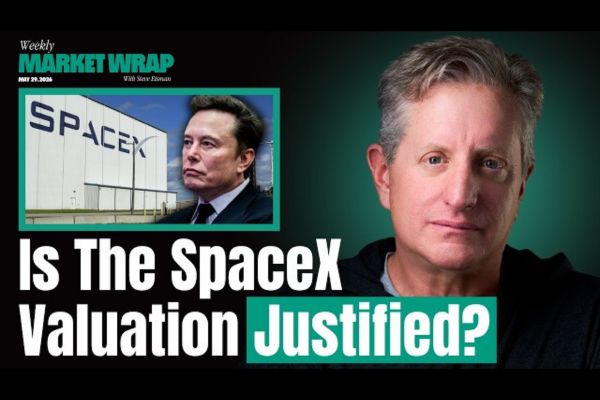
SpaceX IPO, AI Stocks & Market Trends: Key Investment Insights
The past week delivered a mix of geopolitical uncertainty, ambitious technology narratives, and important earnings reports that continue to shape investor sentiment.
While markets continued moving higher, several major themes emerged: ongoing uncertainty surrounding the conflict in the Middle East, the highly anticipated SpaceX IPO, persistent concerns about artificial intelligence's impact on software companies, and renewed debate around financial institutions and ratings agencies.
Markets Continue Higher Despite Geopolitical Uncertainty
One of the most puzzling developments this week was the conflicting narrative surrounding the situation in Iran.
Initial comments suggested that a settlement might be close, creating optimism among investors. However, subsequent developments indicated that no clear resolution had been reached. Despite the uncertainty, markets largely ignored the risks and continued to push higher, suggesting that investors remain optimistic that the situation will eventually stabilize.
This divergence between geopolitical headlines and market behavior highlights how investors are currently focusing more on future growth opportunities than near-term risks.
The SpaceX IPO: A Historic Offering with Extraordinary Expectations
Perhaps the biggest story on Wall Street is the expected public listing of SpaceX.
If completed at the rumored valuation range of $1.75 trillion to $2 trillion, the company would instantly become one of the most valuable businesses in the world.
The company's mission is ambitious: advancing technologies that could eventually make humanity a multi-planetary species. While the vision captures the imagination, the challenge for investors is determining whether the financial fundamentals support such a massive valuation.
Breaking Down SpaceX's Business
SpaceX currently operates across three major segments:
Space Launch Services – Rocket launches and satellite deployment.
Starlink Connectivity – Global internet and communication services.
Artificial Intelligence – Data centers and large language model development.
Among these divisions, Starlink currently appears to be the strongest business, delivering solid growth and generating operating profits.
The launch business remains strategically important but can experience significant fluctuations based on mission schedules and government contracts. Meanwhile, the AI segment remains early-stage and faces intense competition in an increasingly crowded market.
The Valuation Debate
The proposed valuation has sparked considerable debate.
While SpaceX generated meaningful revenue growth, its financial performance currently trails many of the world's largest technology companies in terms of growth rates. Yet the valuation being discussed exceeds what investors typically assign to even the fastest-growing technology leaders.
Supporters argue that investors are paying for future opportunities, including:
Global satellite internet dominance
Advanced AI services
Space infrastructure
Potential future industries such as asteroid mining
Critics argue that these opportunities remain highly speculative and rely heavily on long-term execution rather than current profitability.
Ultimately, SpaceX may become one of the clearest examples of investors paying for a vision of the future rather than present-day earnings.
AI Continues to Pressure the Software Sector
Artificial intelligence remains one of the biggest themes in technology investing, but not necessarily in a positive way for software companies.
Investors are increasingly asking difficult questions:
Will AI reduce the value of existing software products?
Can software companies maintain pricing power?
How much will AI infrastructure costs impact profitability?
Are current business models sustainable?
These concerns continue to weigh on software valuations.
Even companies reporting respectable earnings results are struggling to convince investors that AI will strengthen rather than disrupt their businesses.
Salesforce: Good Results, Limited Enthusiasm
Salesforce reported results that exceeded expectations on several key metrics.
Revenue grew at a healthy pace and earnings surpassed analyst forecasts. However, guidance failed to provide the level of optimism investors were hoping for.
The market reaction reflected a broader challenge facing software companies today: simply beating expectations is no longer enough.
Investors want clear evidence that AI investments will drive meaningful future growth rather than create new competitive pressures.
As a result, software remains one of the more controversial sectors in the market despite recent rallies.
Dell Shows the Power of the AI Infrastructure Boom
While software companies face questions about AI, hardware companies are benefiting directly from the enormous spending required to support it.
Dell delivered impressive results, including:
Strong revenue growth
Significant earnings growth
Raised guidance
Continued momentum from AI infrastructure demand
The results demonstrate that regardless of who ultimately wins the AI race, substantial investments in servers, networking equipment, storage systems, and data centers are already benefiting hardware providers.
The AI infrastructure buildout remains one of the strongest investment themes in technology today.
Banks vs. Ratings Agencies
A recurring question among investors is whether traditional banks or ratings agencies offer better long-term opportunities.
The Case for Banks
Large banks face challenges including:
Regulatory capital requirements
Cyclical credit risk
Sensitivity to economic slowdowns
Dependence on interest rate environments
However, many banks continue to generate attractive returns on equity and remain fundamentally profitable businesses.
As long as the economy avoids a major recession, large financial institutions can continue to perform reasonably well.
The Case for Ratings Agencies
Ratings agencies such as Moody's and S&P Global operate in a fundamentally different business model.
Their advantages include:
Strong competitive positioning
High barriers to entry
Recurring demand tied to debt issuance
Asset-light operations
While issuance activity slowed after the pandemic-era borrowing boom, debt markets appear to be normalizing, which could provide a tailwind for future growth.
For many investors, ratings agencies remain attractive because of their durable competitive advantages and long-term earnings potential.
A Broader Theme: The Economics of Dependency
An emerging theme across technology is the idea that many successful platforms build user dependency while initially subsidizing costs.
This pattern has been visible in:
Ride-sharing platforms
Food delivery services
Streaming businesses
Artificial intelligence applications
As AI becomes more advanced, particularly with the rise of agent-based systems, operating costs increase dramatically. This raises an important question: how long can AI providers continue subsidizing usage before consumers begin paying the true cost?
The answer may significantly influence the future economics of the AI industry.
Final Thoughts
This week highlighted the contrast between powerful narratives and financial realities.
SpaceX represents one of the most ambitious visions ever brought to public markets, but investors must decide whether the valuation matches the fundamentals.
Meanwhile, AI continues to reshape industries, benefiting infrastructure providers while creating uncertainty for software companies.
Geopolitical risks remain unresolved, yet markets continue to focus on growth opportunities rather than potential threats.
As always, the most important challenge for investors is separating compelling stories from sustainable long-term value.
Thanks for reading this week’s wrap.
If you’d like to catch my interviews and market breakdowns, visit The Real Eisman Playbook or subscribe to the Weekly Wrap channel on YouTube.
This post is for informational purposes only and does not constitute investment advice. Please consult a licensed financial adviser before making investment decisions.


