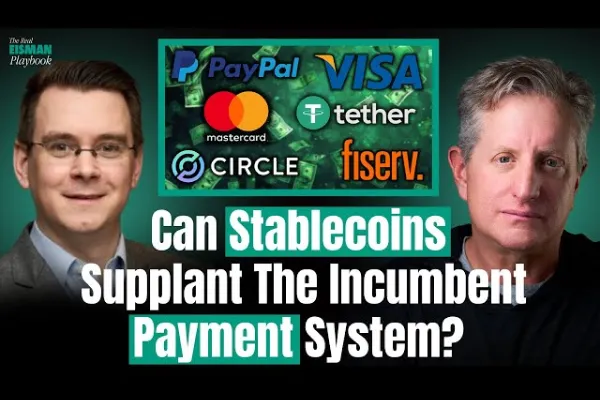
Stablecoins, Payments, and the Unmovable Kings of Finance
The Payments World From the Edge In
This week on The Real Eisman Playbook, I sat down with Ken Sahoski, Autonomous Research’s payments analyst, to unpack one of the most misunderstood ecosystems in finance. Payments look simple on the surface. You tap a card, hear a beep, and walk away. Underneath that moment is a deeply entrenched system with powerful incumbents, fragile challengers, and a new frontier in stablecoins.
We started at the newest edge of the market and worked backward.
What Stablecoins Really Are
Stablecoins are digital tokens designed to maintain a stable value, typically pegged one to one with a fiat currency like the US dollar. You give an issuer a dollar, they mint a token, and they invest that dollar in highly liquid assets, usually short duration US Treasuries.
The dominant use case today is crypto trading. Stablecoins allow traders to move in and out of volatile assets like Bitcoin without converting back to traditional currency. That alone explains most of the roughly 200 billion dollars currently outstanding.
Beyond trading, stablecoins are being used as a store of value in countries with unstable currencies. In places like Argentina, holding a digital dollar can preserve purchasing power in a way local cash cannot.
The most talked about future opportunity is cross border payments. The idea is simple. Stablecoins could move money instantly across borders without correspondent banks, time delays, or opaque fees. In practice, this remains early and complicated, but the inefficiencies are real.
Circle Versus Tether and the Fragility of Trust
The stablecoin market is dominated by two players. Tether controls roughly two thirds of supply. Circle’s USDC represents about a quarter.
Circle is US based, heavily regulated, and focused on transparency. Tether is domiciled offshore and operates with far less disclosure. This creates a structural risk for the entire ecosystem.
If Tether were ever to lose its peg due to asset quality concerns or governance issues, the reputational damage would not stop at Tether. Confidence in stablecoins broadly could be shaken. That is the nightmare scenario for Circle.
Ken’s counterpoint was important. A Tether crisis could ultimately benefit Circle by driving users toward the more regulated alternative. Short term chaos, long term consolidation. Both outcomes are plausible.
Circle as a Business and a Stock
Circle’s business model is straightforward. It earns interest on the assets backing USDC. That makes it highly sensitive to short term interest rates.
When rates fall, revenue falls. A 100 basis point decline in short term rates can reduce gross profit by roughly 30 percent.
At its peak after the IPO, Circle traded at extreme valuations. That enthusiasm has cooled dramatically. After falling from nearly 300 dollars to the 70s, the stock now trades at a far more reasonable multiple.
Ken recently upgraded the stock, citing improving USDC growth, conservative guidance, and better risk reward. His price target is around 120 dollars, with the key variable being how quickly USDC supply grows over the next few years.
Why Stablecoins Struggle in Consumer Payments
Stablecoins face brutal competition in consumer payments. Credit cards offer rewards, fraud protection, and habit driven convenience. Consumers pay the same price regardless of payment method, so lower merchant costs do not motivate switching.
There is no obvious way for stablecoins to fund cash back programs or match the protections offered by card networks. That makes widespread consumer adoption unlikely.
The real opportunity, if it comes, is in business to business and cross border payments where inefficiencies still dominate.
Inside a 100 Dollar Card Transaction
To understand why incumbents are so hard to dislodge, Ken broke down a typical transaction.
On a 100 dollar purchase, the merchant pays roughly 2.75 dollars in fees.
About 2 dollars goes to the issuing bank.
Roughly 50 cents goes to the merchant acquirer.
Visa or Mastercard keep about 25 cents.
The networks take the smallest cut while owning the most powerful position.
Why Visa and Mastercard Cannot Be Disrupted
Every few years, new companies claim they will replace Visa and Mastercard. Every time, they fail and eventually partner with them.
The reasons are structural.
These networks solved the many to many problem. They connect thousands of banks to over 150 million merchants worldwide. They are trusted globally. They have massive network effects, long term contracts, high switching costs, and extraordinary economics.
They also require enormous fixed investment. To break even as a global network, a challenger would likely need 15 to 20 percent market share. That alone deters most would be disruptors.
For long term investors, the thesis remains simple. If you want durable pricing power outside traditional banking, Visa and Mastercard still stand alone.
The Pain Elsewhere in Payments
Outside the networks, it has been a brutal year.
Fiserv is down roughly 70 percent following years of underinvestment, customer dissatisfaction, and a painful reset under new management.
Block and PayPal have struggled as competition increased and business mixes shifted toward lower multiple lending activities.
Toast stands out as a relative bright spot due to its vertical focus and strong execution in restaurants.
Across the sector, only a handful of names outperformed the market. Starting valuations are now much lower, which improves future return potential, but selectivity matters more than ever.
Final Takeaway
Payments look simple but they are anything but.
Stablecoins may grow, but trust and regulation will determine who survives. Consumer payments remain locked up by powerful networks. Disruption is far harder than the pitch decks suggest.
For now, the kings of payments remain firmly on their thrones.
Until next time, this is Steve Eisman, and this has been The Real Eyesman Playbook. .
If you’d like to catch my interviews and market breakdowns, visit The Real Eisman Playbook or subscribe to the Weekly Wrap channel on YouTube.
This post is for informational purposes only and does not constitute investment advice. Please consult a licensed financial adviser before making investment decisions.


