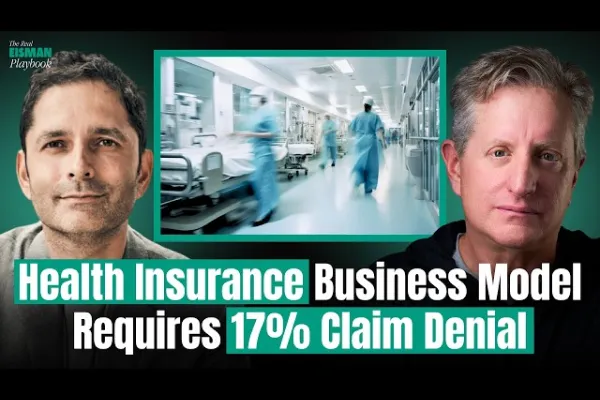
The Real Crisis in American Health Insurance: Denials, Incentives, and Moral Injury
The Real Crisis in American Health Insurance: Denials, Incentives, and Moral Injury
This conversation is not about stocks, valuations, or markets.
It is about people.
The United States health care system touches every American, yet few truly understand how broken it has become. Denials are no longer edge cases. They are structural. They are automated. And they are quietly devastating families across the country.
What follows is a clear look at the fundamental nature of the problem, why it has worsened, and why it now represents one of the most severe moral and economic crises of our time.
The Scale of the Denial Problem
Each year in the United States, roughly five billion medical claims are submitted.
On average, 15 to 20 percent of those claims are denied on first pass.
That translates to 850 million denied claims annually, impacting an estimated 70 to 90 million Americans every year.
This is not a fringe issue. It affects between one in three and one in five insured Americans annually.
Even more alarming, when patients appeal those denials, 50 to over 90 percent are overturned, depending on the category of care.
The implication is unavoidable.
A large portion of denials should never have happened in the first place.
Why Denials Persist Despite Being Wrong
Less than 1 percent of denied claims are appealed.
Not because people do not deserve coverage, but because appealing is hard. It requires time, medical knowledge, paperwork, emotional energy, and persistence, often when someone is already sick or caring for a loved one.
Insurers know this.
The system relies on what is known internally as breakage. Claims that are denied and quietly abandoned.
The Role of AI in Denials
Denials today are not primarily human decisions.
Claims are often reviewed and denied in seconds, sometimes under two seconds, using automated systems and AI models.
These systems frequently rely on:
Outdated internal policy databases
Narrow interpretations of medical necessity
Incomplete clinical context
When appeals occur, insurers are legally required to use qualified human reviewers. That is why appeals succeed at such high rates.
The problem is not medical judgment.
The problem is economic incentives.
Medical Loss Ratios and the Real Business Model
Health insurance is often misunderstood as a health care business.
It is not.
It is a financial products business with extremely thin margins.
Insurers track something called the medical loss ratio. This measures how much of each premium dollar goes to paying for care. Once that ratio exceeds roughly 90 percent, insurers lose money after operating costs.
As health care costs rise, insurers face a choice:
Accept lower profits or losses
Delay, deny, or restrict payments
The system has chosen the latter.
Why the Problem Is Getting Worse Now
Several structural forces are colliding at once.
Short-Term Risk, Long-Term Illness
Most people remain with the same employer and insurance plan for only 18 to 24 months. Insurers therefore have little incentive to fund expensive long-term treatments that may benefit someone who soon leaves their plan.
Consolidation of Providers
Independent medical practices are being crushed by delayed payments, clawbacks, and administrative costs. Many are forced to sell to large hospital systems.
Once care shifts from clinics to hospitals, prices rise sharply.
Vertical Integration
Insurers now own:
Clinics
Physician groups
Pharmacies
Pharmacy benefit managers
This allows them to pay themselves higher rates than independent providers, squeezing competitors out of business and distorting prices across the system.
Medicare Advantage: A Broken Arbitrage
Medicare Advantage was designed as a private alternative to traditional Medicare. For years it was wildly profitable due to aggressive risk coding.
Plans maximized diagnosis codes to appear to manage sicker populations, increasing government payments, while simultaneously denying care.
Recent regulatory changes reduced those excess codes, collapsing the economics of many Medicare Advantage businesses.
The result has been:
Divestitures
Write-downs
Increasing denial pressure
Medicaid and ACA Instability
Medicaid
During the pandemic, disenrollment was paused. When it resumed, healthier individuals were removed, often for paperwork reasons, leaving a smaller and sicker pool.
Medical loss ratios spiked, catching insurers unprepared.
ACA
Affordable Care Act plans face exploding premiums driven by:
Drug pricing structures
Provider consolidation
Pharmacy benefit manager rebates
Shrinking healthier enrollment
If subsidies expire, younger and healthier participants will exit, pushing costs even higher and driving more uninsured patients into emergency rooms.
The Human Cost
Behind every denial is a story.
Parents selling homes to fund care.
Cancer patients denied evidence-based treatments.
Transplant patients dying while waiting for approvals.
Doctors being fired for advocating for patients.
One statistic captures the severity of the crisis:
50 percent of cancer patients in the United States go bankrupt within two years of diagnosis.
This is not a health care system failure.
It is a societal failure.
Why Appeals Work and Why They Matter
Appeals are expensive for insurers.
Each appeal costs an estimated $800 or more to process. Claim file production can add thousands more. Litigation costs far exceed that.
If appeal rates rose from 1 percent to just 3 percent, denial-driven economics would break.
That is why appeals are discouraged through complexity, delay, and exhaustion.
What Claimable Does
Claimable is a technology platform that helps patients appeal unfair denials.
For a flat fee of about $50, patients:
Tell their medical story
Document treatment history
Cite clinical evidence and guidelines
Reference insurer policy contradictions
Escalate to regulators when necessary
Appeals are structured, evidence-based, and targeted.
The goal is not confrontation.
The goal is accountability.
The Fundamental Problem
The core issue is simple but devastating.
Health insurance in the United States is optimized for financial survival, not human health.
It relies on:
Short-term risk horizons
Automated denials
Administrative exhaustion
Patient abandonment
This is not sustainable.
What Real Solutions Would Require
There is no single fix, but meaningful reform would include:
Breaking up vertically integrated monopolies
Transparent pricing and cost accounting
Portable risk structures that follow patients
Stronger employer oversight of health plans
Scaled patient advocacy
Without these changes, denial will remain the default.
A Final Thought
The most dangerous part of this system is not inefficiency.
It is normalization.
Practices that once horrified audiences in movies are now praised as cost control. Moral injury has been rebranded as operational discipline.
Fixing this system begins with refusing to accept that as normal.
Until next time, this is Steve Eisman, and this has been The Real Eyesman Playbook. .
If you’d like to catch my interviews and market breakdowns, visit The Real Eisman Playbook or subscribe to the Weekly Wrap channel on YouTube.
This post is for informational purposes only and does not constitute investment advice. Please consult a licensed financial adviser before making investment decisions.


