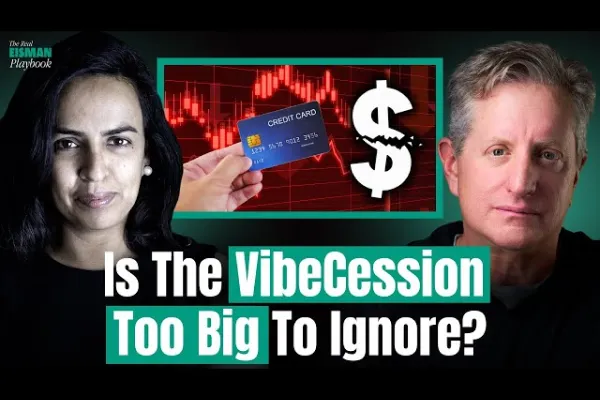
The “Vibe Session” Economy: Why the Consumer Looks Fine Until It Doesn’t
The Data Says Fine. The Consumer Says Otherwise.
Bank earnings over the last two weeks looked reassuring.
Charge-offs are stable. Provisions haven’t surged. Spending is still rising. On the surface, the U.S. consumer appears intact.
But Lakshmi Ganapathy of Unicus Research argues that this is exactly the problem:
The numbers look fine… while the consumer is breaking underneath.
She calls it a “vibe session”—a disconnect between what the statistics show and what households actually feel.
Consumer sentiment is near multi-decade lows.
Yet credit metrics remain calm.
That gap is the warning signal.
The Recession Is Already Here — Just Not for Everyone
Ganapathy’s central claim is blunt:
The recession is already here.
This isn’t a 2008-style collapse across all income levels. It’s a recession concentrated in the lower end of the K-shaped economy.
The bottom consumer is already suffering.
The top consumer is still spending.
And aggregate data hides that divergence.
The Cascading Consumer: From $150K to Subprime Stress
One of the most important dynamics Unicus sees is what Lakshmi calls “cascading.”
Households earning $100K–$150K are being pushed downward—not into poverty, but into fragility.
They no longer have cushion.
The invisible costs have surged:
Car repairs up 45–50% since COVID
Insurance rising sharply
Maintenance, food, and everyday expenses compounding
Debt-to-income ratios that used to sit around 30% are now closer to 60%.
That means consumers can’t access incremental credit even if their credit scores look fine.
They’re surviving…
But barely.
Credit Scores Are Inflated and Subprime Is “Mushed Up”
A key point: subprime is larger than it appears.
During COVID, stimulus checks allowed many borrowers to pay down debt temporarily, which artificially boosted FICO scores.
So credit profiles look healthier than affordability reality.
Subprime didn’t disappear.
It was masked.
Now stimulus is gone, and households are working two or three jobs just to maintain baseline spending.
Why Aren’t Bank Credit Metrics Cracking Yet?
Eisman presses the obvious question:
If consumers are stressed, why aren’t delinquencies exploding?
Ganapathy’s answer:
Buy Now, Pay Later.
BNPL has become the bridge between paychecks.
Consumers are financing:
Rent
DoorDash
Amazon purchases
Everyday essentials
And because BNPL loans are fragmented across multiple issuers, borrowers lose track.
A striking statistic:
Nearly 19% of BNPL users forget they owe payments.
That’s not stability.
That’s deferred stress.
The Real Deterioration Is Showing Up in ABS Markets
Another reason banks look fine: they’re offloading risk.
Auto lenders originate loans and then securitize them immediately into asset-backed securities.
The loan disappears from the bank’s balance sheet.
The deterioration doesn’t.
In ABS data, Unicus sees:
Rising loan modifications
Increasing repossessions
Compressing excess spread
Weakening cushions in loan pools
The credit sickness is real—it’s just moved outside traditional bank reporting.
Auto Lending Has Become Absurd
COVID-era vehicle pricing created a structural problem:
Dealers marked up cars by $10K–$12K over MSRP due to shortages.
That means many borrowers were upside-down on day one.
Now used cars depreciate faster, repairs cost more, and consumers can’t trade in because negative equity is too large.
A shocking development:
100-month car loans are now being offered on depreciating assets.
That’s not growth.
That’s desperation.
“Extend and Pretend” Has Spread Everywhere
Commercial real estate is following the same playbook.
Loans coming due cannot be refinanced at today’s rates.
Instead of forcing losses, lenders restructure:
Extend maturities
Reduce payments
Avoid marking to market
Nobody wants to show losses first.
It’s a house of cards dynamic.
And regulators aren’t stopping it.
As Lakshmi put it:
Everyone is extending and pretending.
Private Credit Is the Quiet Systemic Risk
Unicus is especially concerned about private credit’s expansion.
Private credit is now embedded in:
Auto lending
BNPL financing
Consumer credit
Retirement accounts
Most dangerously, it is being inserted into target-date retirement funds—products people treat as safe and forget about.
The core risk is opacity:
Minimal disclosure
No real-time pricing
No liquidity
Blow-ups only become visible after they happen
First Brands is the template: no one knew until it was gone.
FICO’s Monopoly May Be Breaking
Unicus also highlighted an emerging structural shift:
FICO is backward-looking.
Lenders are building near real-time underwriting models based on transaction behavior, overdrafts, and point-of-sale credit signals.
BNPL providers already do this quietly.
The future credit score may not come from Fair Isaac.
It may come from live cash-flow surveillance.
That threatens one of the longest-standing monopolies in consumer finance.
Data Centers: Demand Is Real, Power Is the Constraint
Another theme: the data center boom is colliding with infrastructure reality.
Projects are being quietly canceled due to:
Local political backlash
Electricity costs rising 25–30%
Water usage concerns
Grid capacity constraints
The bottleneck isn’t AI demand.
It’s power.
The U.S. grid is aging, overstretched, and unprepared.
The Bottom Line on the Consumer
Ganapathy’s five-minute diagnosis is simple:
The invisible costs of life have surged.
Wages have not kept up.
Consumers are stretched thin.
Credit looks fine only because:
Risk is being securitized away
BNPL is masking stress
Lenders are modifying loans
Losses are being delayed
The recession isn’t coming.
For millions, it’s already here.
The first real crack will appear when spending finally breaks.
And when it does, the data will catch up—late, as always.
Until next time, this is Steve Eisman, and this has been The Real Eyesman Playbook. .
If you’d like to catch my interviews and market breakdowns, visit The Real Eisman Playbook or subscribe to the Weekly Wrap channel on YouTube.
This post is for informational purposes only and does not constitute investment advice. Please consult a licensed financial adviser before making investment decisions.


