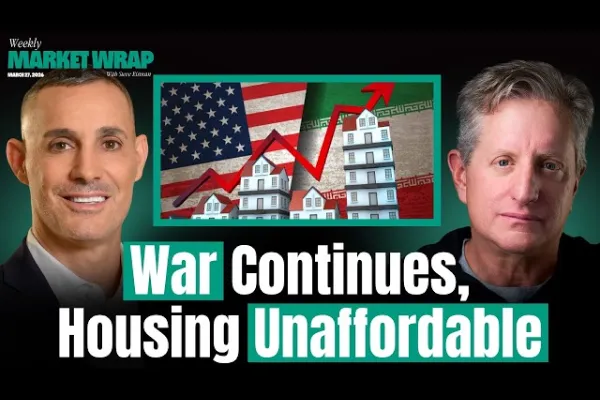
War, Credit, and Housing — The Three Forces Driving Markets Right Now
Right now, if you’re trying to analyze the market using fundamentals, you’re going to feel like nothing makes sense.
That’s because, for the moment, fundamentals don’t matter.
The market has shifted into something much simpler — and much more dangerous:
It’s trading headlines.
Every move is tied to the war with Iran. Oil spikes, markets drop. A comment about negotiations appears, markets rally. Iran denies talks, markets fall again. This isn’t valuation. It’s reaction.
And until that uncertainty clears, this behavior won’t change.
The Bigger Problem Nobody Is Watching
While everyone is glued to geopolitical headlines, something far more structural is quietly unfolding in the background:
Private credit is starting to crack.
You’re seeing large funds hit with double-digit redemption requests, but only allowing a fraction of withdrawals. Ratings agencies are downgrading funds to junk. Non-performing loans are rising.
This is not random noise.
This is what the early stage of a credit cycle looks like.
It never starts with a collapse. It starts with friction:
withdrawals get limited
risk gets repriced
lenders quietly pull back
And once that process begins, it tends to feed on itself.
The real danger here is not what’s already happened — it’s what comes next.
Why This Matters More Than the War
Geopolitics drives volatility.
Credit drives outcomes.
If credit tightens meaningfully, it doesn’t matter what the headlines say — businesses lose access to capital, growth slows, and eventually, the economy feels it.
That’s how recessions actually form.
Not from a single event, but from a tightening system.
Now Add Housing Into the Equation
At the same time, you have another pressure point: housing.
On the surface, demand still exists. The U.S. is structurally underbuilt. There are more people who want homes than there are homes available.
But beneath that, the system is strained.
Affordability is collapsing. Consumer confidence is weakening. Interest rates are still high enough to lock people out of decisions.
And the most important detail — the one almost nobody talks about — is what’s actually driving housing costs.
The Real Reason Homes Are Expensive
It’s not labor.
It’s not materials.
It’s land and regulation.
In some regions, before a builder even starts construction, they’re already paying six figures per home just in regulatory costs. Permits, fees, approvals — all layered on before a single brick is laid.
That cost doesn’t disappear.
It flows directly into the final price the buyer pays.
And the system is designed in a way that keeps it that way.
Local governments have little incentive to reduce prices. Higher home values benefit existing homeowners. So instead of enabling cheaper housing, they often enforce:
larger lot sizes
higher building standards
more fees
All of which push prices higher.
The System Is Working Exactly As Designed
That’s the uncomfortable truth.
Housing isn’t expensive because of inefficiency.
It’s expensive because:
the incentives reward it being expensive
Which is why this problem is so hard to fix.
It’s not a federal issue. It’s local. And local systems don’t change quickly.
Bringing It All Together
Right now, you’re looking at three forces operating at the same time:
Geopolitical instability — driving short-term volatility
Credit tightening — signaling medium-term risk
Housing constraints — creating long-term pressure
Individually, each is manageable.
Together, they form something much more fragile.
If the war escalates, inflation stays high.
If inflation stays high, rates stay high.
If rates stay high, housing and credit both tighten further.
And that’s how systems start to break.
What Most People Are Missing
People are focused on the noise — headlines, daily moves, short-term reactions.
But the real story is structural.
The market isn’t behaving irrationally.
It’s just responding to a different set of drivers than most people are used to.
And until those drivers change, the playbook has to change too.
If You Want My Direct Take
You’re looking at the early stages of a transition phase.
Not a crash. Not a boom.
But a shift.
And in these phases, the biggest mistake you can make is assuming the old rules still apply.
Thanks for reading this week’s wrap.
If you’d like to catch my interviews and market breakdowns, visit The Real Eisman Playbook or subscribe to the Weekly Wrap channel on YouTube.
This post is for informational purposes only and does not constitute investment advice. Please consult a licensed financial adviser before making investment decisions.


