War, Oil Prices, and the Rise of a New Credit Cycle
Markets Are No Longer Driven by Fundamentals
Right now, traditional investing frameworks are breaking down.
Instead of analyzing earnings, valuations, or growth projections, markets are reacting almost entirely to geopolitical uncertainty—specifically the war involving Iran.
Oil prices have surged above $100, and that single variable is now driving:
Equity market declines
Rising bond yields
Inflation expectations
Global economic risk
The S&P 500 and NASDAQ are both down, while volatility is being dictated by headlines rather than fundamentals.
Oil Prices Are the Core Risk
Oil is not just another commodity—it is a systemic input into the global economy.
When oil rises sharply, it cascades through multiple sectors:
Plastics and manufacturing → higher input costs
Food production → fertilizer prices surge
Air travel → higher fuel costs passed to consumers
In fact, fertilizer prices have already jumped significantly—from $700 to $1,000 per ton, a 43% increase.
This is a clear signal: inflation pressure is building.
Inflation Depends on One Variable: Duration of War
The economic outcome hinges on a single factor—how long the conflict lasts.
Short-term conflict (weeks):
Minimal long-term inflation impactExtended conflict (months):
Sustained inflation + rising expectations
If the war continues, inflation becomes embedded, and central banks lose flexibility.
Why Bonds Are Falling Instead of Rising
In times of crisis, investors typically move into U.S. Treasuries, pushing yields down.
This time, the opposite is happening.
10-year yields rose from 4.0% to 4.3%
Investors are selling both stocks and bonds
This signals something deeper:
Markets are not just pricing risk—they are pricing inflation risk.
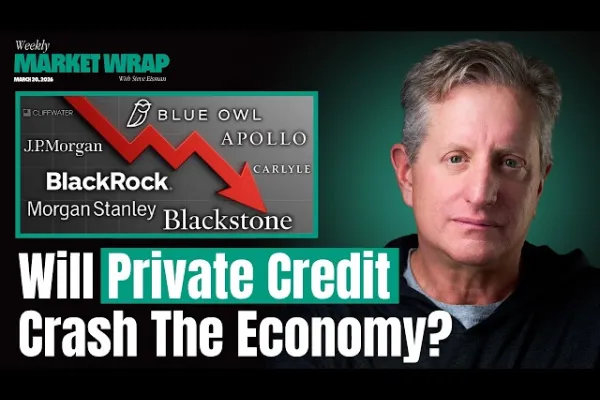
The Bigger Structural Risk: A Credit Cycle Is Emerging
Beyond geopolitics, a more structural risk is forming:
The return of a credit cycle.
The U.S. has not experienced a true credit cycle since the 2008 financial crisis.
Many analysts now believe:
We are overdue.
Understanding Private Credit
Private credit has quietly become one of the largest financial markets.
Size today: $1.8 trillion
Size 10 years ago: $300 billion
That growth is massive.
What is private credit?
It refers to non-bank lending, where institutions lend directly to companies.
Key segments include:
Direct lending
Loans to companies, often backed by private equityAsset-backed finance
Loans secured by assets like mortgages, receivablesDistressed/opportunistic lending
Capital for struggling or restructuring companies
The Structural Problem: Illiquidity + Retail Money
Historically, private credit was funded by institutional investors.
Now, firms are raising money from:
Retail investors
401(k) plans
Brokerage clients
This creates a mismatch:
The assets are illiquid
But investors expect liquidity
To manage this, funds cap withdrawals at 5–7% per quarter
When redemption requests exceed this:
Withdrawals are restricted
Investors get stuck
This is already happening.
Early Warning Signs Are Appearing
Recent developments suggest stress is building:
Redemption requests exceeding limits
Funds honoring only partial withdrawals
Large firms stepping in to cover gaps
At the same time:
Loan valuations are being marked down
Especially in software sector exposure
Why Software Is the Weak Link
Private credit is heavily exposed to software companies.
Estimated ~25% of loans tied to software
Many of these companies were acquired:
Between 2018–2022
At high valuations
Under low interest rates
Now the risks are compounding:
AI disruption
Cheaper alternatives threatening incumbentsRefinancing risk
11% of loans need refinancing by 2027
20% by 2028
Higher interest rates
New debt will be significantly more expensive
The key question:
Who will refinance these companies if performance deteriorates?
The Circular Risk in Private Equity
There is also a structural loop:
Private equity firms buy companies
Their own credit arms finance those purchases
This creates:
Circular capital flows
Concentrated risk
If one side weakens, the entire system is exposed.
Why This Matters: Where Growth Happens, Risk Builds
Historically, credit crises emerge where lending grows fastest.
Examples:
2008 → subprime mortgages
Today → private credit
Since the financial crisis:
Banks slowed lending
Private credit filled the gap
This makes it the primary risk center today.
Is This a Real Crisis or Just a Narrative?
There is an important distinction:
Credit cycle (real deterioration)
News cycle (fear-driven narratives)
Right now, we are early.
Problems are emerging—but not yet systemic.
However, the trajectory is clear:
Losses are beginning to surface.
AI Spending: The Other Major Risk
Parallel to credit markets, another macro question remains:
Will AI justify its massive investment?
Despite skepticism:
Spending continues aggressively
NVIDIA expects $1 trillion in AI chip demand by 2027
There are two competing views:
Bull case: AI transforms industries
Bear case: Returns won’t justify capital
So far, markets are still betting on the bull case.
Final Synthesis
There are three overlapping forces shaping markets right now:
1. Geopolitical Risk
War is driving oil → oil is driving inflation → inflation is driving markets
2. Structural Financial Risk
Private credit expansion is now facing its first real stress test
3. Technological Bet
AI investment is massive—but returns remain uncertain
The Real Takeaway
The most important shift is this:
Markets are transitioning from a liquidity-driven environment to a risk-aware environment.
If the war is prolonged and credit stress accelerates:
Inflation rises
Rates stay high
Weak balance sheets break
That’s how cycles begin.
Not suddenly—but gradually, then all at once.
Thanks for reading this week’s wrap.
If you’d like to catch my interviews and market breakdowns, visit The Real Eisman Playbook or subscribe to the Weekly Wrap channel on YouTube.
This post is for informational purposes only and does not constitute investment advice. Please consult a licensed financial adviser before making investment decisions.


